
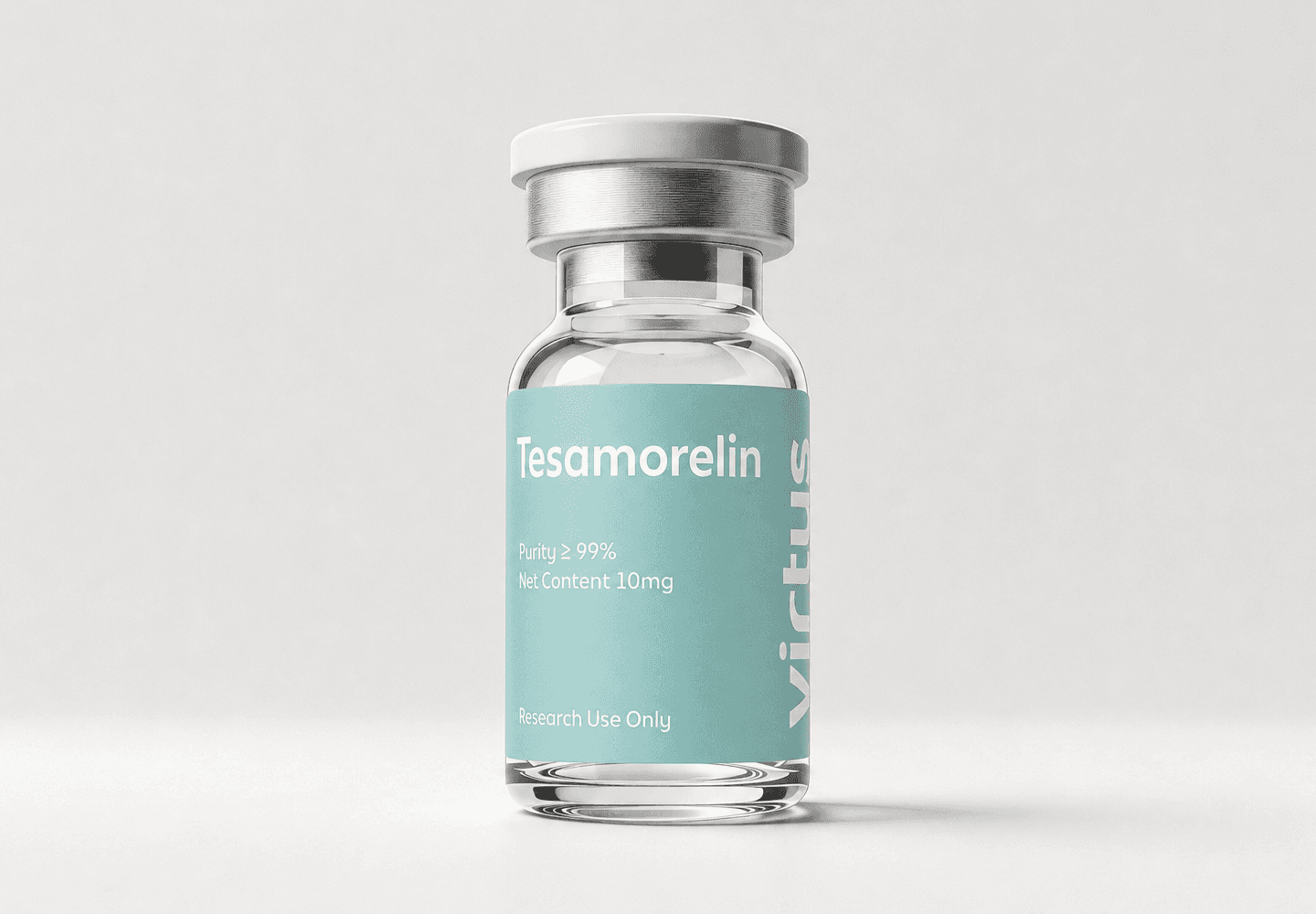
Tesamorelin
GHRH Analogue
Also referenced as: TH9507 · GHRH(1-44) Analogue · Trans-3-Hexenoyl-GHRH(1-44)NH₂ · Egrifta (clinical brand name)
≥99% Release Requirement
Full Panel COA
Free Shipping At $125+
Shipping Protection
Lab Results
| Test | Result | Status |
|---|---|---|
| Purity | – | Pending |
| Quantitation (Avg) | – | Pending |
| Heavy Metals (ICP-MS) | – | Pending |
| Endotoxin (USP <85>) | – | Pending |
| Rapid Microbial Screen | – | Pending |
| Multi Vial Tested | – | Pending |
Curated research on Tesamorelin
Stanley TL (2019). Effects of tesamorelin on non-alcoholic fatty liver disease in HIV: a randomised, double-blind, multicentre trial Lancet HIV.
PMID: 31611038 →Russo SC (2024). Efficacy and safety of tesamorelin in people with HIV on integrase inhibitors AIDS.
PMID: 38905488 →Lake JE (2021). Tesamorelin improves fat quality independent of changes in fat quantity AIDS.
PMID: 33756511 →Falutz J (2007). Metabolic effects of a growth hormone-releasing factor in patients with HIV N Engl J Med.
PMID: 17855669 →
About Tesamorelin
A synthetic analogue of growth hormone-releasing hormone (GHRH) with enhanced molecular stability. Investigated in preclinical models for its selective activity at GHRH receptors and downstream effects on pituitary signaling cascades.
Tesamorelin is a 44-amino acid synthetic GHRH analogue stabilized by a trans-3-hexenoic acid N-terminal conjugate. Published research in controlled laboratory models has examined selective GHRH receptor engagement, downstream somatotroph signaling, and IGF-1 axis modulation at the cellular level. Studied within endocrine and metabolic signaling pathway research contexts.
Also Referenced As
TH9507 · GHRH(1-44) Analogue · Trans-3-Hexenoyl-GHRH(1-44)NH₂ · Egrifta (clinical brand name)
Sourced through an established North American supply partner that conducts onsite manufacturer reviews against documented cGMP practices and applicable ISO quality criteria. Virtus Peptides tracks the factory batch number on every lot and catalogues it against independent lab testing, with a final Certificate of Analysis from ILS Laboratories. We pay more to source this way because we hold ourselves to a rigorous, documented standard for the product and for you.
Specifications
- Scientific Name
- Tesamorelin: GHRH Analogue
- CAS Number
- 218949-48-5
- Molecular Formula
- C₂₂₁H₃₆₆N₇₂O₆₇S
- Molecular Weight
- 5,135.86 g/mol
- Physical Form
- Lyophilized powder
- Purity
- 99%+
- Storage
- −20°C, protected from light
Storage & Handling
Store per the product label and available manufacturer handling documentation, and follow standard laboratory protocols for handling.
Storage
Store the lyophilized powder at −20°C in a standard laboratory freezer, protected from light, moisture, and heat. Avoid repeated freeze-thaw cycles.
Shelf Life
Per the manufacturer, the lyophilized powder remains stable for 12–24 months when stored frozen in its original sealed vial. Our release testing verifies identity, purity, content, and the contaminant panels and does not itself establish shelf life.
Mechanism & Research Background
Tesamorelin is a synthetic 44-amino acid analogue of human growth hormone-releasing hormone (GHRH). The molecule is engineered with a trans-3-hexenoic acid moiety covalently attached at the N-terminal tyrosine, a modification that confers significant resistance to enzymatic cleavage by dipeptidyl peptidase-4 (DPP-4). The result is a peptide with substantially extended plasma stability relative to native GHRH while preserving full receptor agonist activity at the human growth hormone-releasing hormone receptor (GHRHR). Identified in early research literature under the developmental code TH9507, tesamorelin received regulatory approval under the brand name Egrifta for clinical indications outside the scope of research-use-only material.
In receptor pharmacology research, tesamorelin acts as a selective full agonist at the pituitary GHRHR, a class B G-protein-coupled receptor. Receptor engagement initiates Gαs-mediated adenylyl cyclase activation and intracellular cAMP elevation in somatotroph cell models, triggering pulsatile growth hormone (GH) release. Unlike short-acting GH-releasing peptides (e.g. ipamorelin, GHRP-6) that act through the ghrelin/GHS-R pathway, tesamorelin operates upstream through the native GHRH axis, preserving the physiological pulsatility of GH secretion observed in cellular and preclinical research models.
Studied effects in research models include stimulation of pituitary GH release, downstream IGF-1 axis modulation, and characterized effects on adipose-tissue metabolism, particularly visceral adipose tissue research endpoints. Clinical research literature has examined tesamorelin in HIV-associated lipodystrophy and metabolic dysfunction-associated fatty liver disease research contexts (Stanley et al., Lancet HIV, 2019; Lake et al., AIDS, 2021; Russo et al., AIDS, 2024). Tesamorelin remains widely referenced in endocrine signaling and GH-axis research literature; products supplied by Virtus Peptides are intended exclusively for in-vitro laboratory research.
Frequently Researched Questions
What is tesamorelin?
Tesamorelin is a synthetic 44-amino acid analogue of growth hormone-releasing hormone (GHRH), modified with a trans-3-hexenoic acid moiety at the N-terminus to resist enzymatic degradation. It is referenced in early research literature under the developmental code TH9507. Virtus Peptides supplies tesamorelin as a lyophilized powder strictly for in-vitro laboratory research.
How does tesamorelin differ from native GHRH?
Native GHRH(1-44) is rapidly degraded by dipeptidyl peptidase-4 (DPP-4), giving it a plasma half-life of only minutes. Tesamorelin's N-terminal trans-3-hexenoic acid modification protects against DPP-4 cleavage while preserving full agonist activity at the human GHRH receptor, substantially extending its stability profile in research models.
What is tesamorelin's molecular weight?
Tesamorelin has a molecular weight of approximately 5,135.86 g/mol with the molecular formula C₂₂₁H₃₆₆N₇₂O₆₇S. Reflecting its 44-amino acid backbone plus the N-terminal trans-3-hexenoic acid conjugate.
How does tesamorelin compare to GHRP-6 or ipamorelin?
Tesamorelin is a GHRH-receptor agonist (acts upstream on the native growth hormone axis), while GHRP-6 and ipamorelin are GH secretagogues that act through the ghrelin/GHS-R pathway. The two classes engage different receptors and are studied in distinct research contexts within GH-axis literature.
What testing does Virtus Peptides run on tesamorelin?
Every batch of Virtus Peptides tesamorelin is independently tested by ILS Laboratories (ISO/IEC 17025 accredited) across the full QC panel: purity and quantitation by HPLC, heavy metals by ICP-MS (lead, arsenic, cadmium, chromium, and mercury), bacterial endotoxin by USP <85>, and a rapid microbial screen (DNA microarray). Three vials provide the material required for the complete ILS quality control panel, and two additional vials are each tested for HPLC purity, identity, and net peptide content to evaluate conformity. The full Certificate of Analysis is published in our COA database before any vial ships.
What is the recommended storage temperature for tesamorelin?
Lyophilized tesamorelin should be stored at −20°C, protected from light, in the original sealed vial. Repeated freeze-thaw cycles should be avoided. Per the manufacturer, the sealed lyophilized material has a stated frozen storage period of 12 to 24 months. Virtus Peptides release testing does not independently establish product shelf life.
Where can I find published research on tesamorelin?
Published peer-reviewed research on tesamorelin is indexed on PubMed under both the chemical name "Tesamorelin" and the developmental code "TH9507". Foundational work appears in journals including Lancet HIV, AIDS, and JCEM, with multiple phase 2 and phase 3 clinical research papers examining endpoints in HIV-associated lipodystrophy and visceral adipose tissue research.