
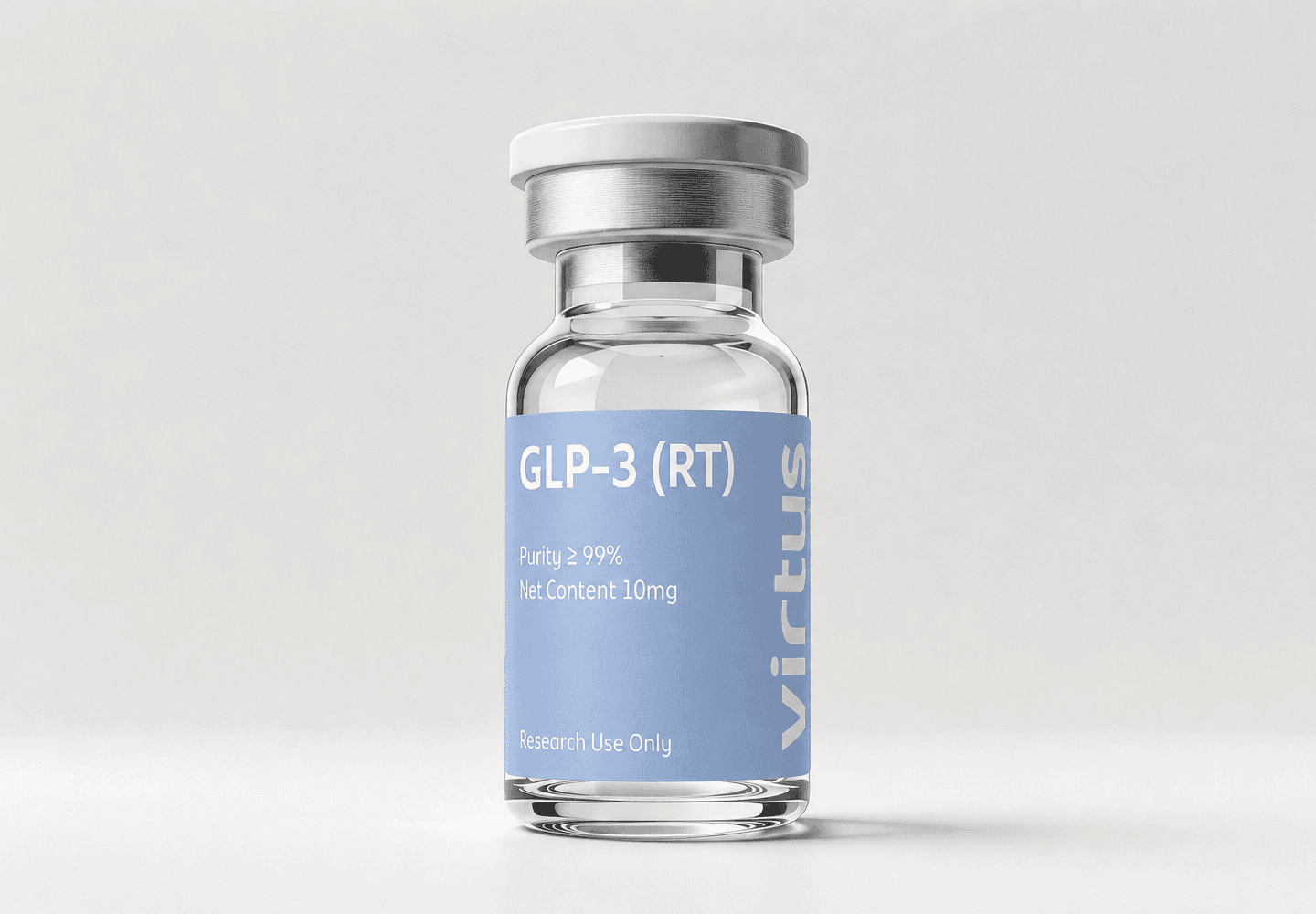
GLP-3 (RT)
GLP‑1 / GIP / Glucagon Triple Agonist
Also referenced as: Retatrutide · LY3437943 · GLP-1 / GIP / Glucagon Triple Receptor Agonist · Triagonist Peptide · Triple-Hormone-Receptor Agonist
≥99% Purity Guaranteed
Full Panel COA
Free Shipping At $125+
Shipping Protection
Lab Results
| Test | Result | Status |
|---|---|---|
| Purity | 99.62% | PASS |
| Quantitation (Avg) | 10.44 mg | PASS |
| Heavy Metals (ICP-MS) | Pass | PASS |
| Endotoxin (USP <85>) | NMT 0.05 EU/mL | PASS |
| Rapid Microbial Screen | No Growth | PASS |
| Multi Vial Tested | 5 Vials | PASS |
Heavy Metals Breakdown (ICP-MS)
| Analyte | Result | Status |
|---|---|---|
| Arsenic (As) | 0.335 ppm | PASS |
| Cadmium (Cd) | 0.1006 ppm | PASS |
| Lead (Pb) | 0.1005 ppm | PASS |
| Mercury (Hg) | 0.1087 ppm | PASS |
| Chromium (Cr) | 0.1387 ppm | PASS |
LOT ZQ-20260610-RT10 · Batch RT10-655 · Tested Jul 1, 2026 · ILS
Curated research on GLP-3 (RT)
Jastreboff AM (2023). Triple-Hormone-Receptor Agonist Retatrutide for Obesity: A Phase 2 Trial N Engl J Med.
PMID: 37366315 →Rosenstock J (2023). Retatrutide, a GIP, GLP-1 and glucagon receptor agonist, for people with type 2 diabetes: a randomised, double-blind, placebo and active-controlled, parallel-group, phase 2 trial Lancet.
PMID: 37385280 →Sanyal AJ (2024). Triple hormone receptor agonist retatrutide for metabolic dysfunction-associated steatotic liver disease: a randomized phase 2a trial Nat Med.
PMID: 38858523 →Coskun T (2022). LY3437943, a novel triple glucagon, GIP, and GLP-1 receptor agonist for glycemic control and weight loss: From discovery to clinical proof of concept Cell Metab.
PMID: 35114046 →
About GLP-3 (RT)
A synthetic triple receptor agonist investigated in preclinical research for its activity at GLP-1, GIP, and glucagon receptors simultaneously. GLP-3 (RT) is among the most studied next-generation metabolic research compounds in current literature, with published data examining receptor binding kinetics, downstream signaling cascades, and energy homeostasis mechanisms at the cellular level.
LY3437943 is a triagonist peptide activating GLP-1, GIP, and glucagon receptors in concert. Preclinical data examines comparative receptor engagement versus dual agonists in adipose tissue models, hepatic lipid clearance pathways, and glucose-insulin axis signaling. Its extended half-life profile is conferred by a C20 fatty acid conjugate enabling an extended characterized half-life in research models.
Also Referenced As
Retatrutide · LY3437943 · GLP-1 / GIP / Glucagon Triple Receptor Agonist · Triagonist Peptide · Triple-Hormone-Receptor Agonist
Sourced through an established North American supply partner that conducts onsite manufacturer reviews against documented cGMP practices and applicable ISO quality criteria. Virtus Peptides tracks the factory batch number on every lot and catalogues it against independent lab testing, with a final Certificate of Analysis from ILS Laboratories. We pay more to source this way because we hold ourselves to a rigorous, documented standard for the product and for you.
Specifications
- Scientific Name
- GLP-3 (RT): GLP-1/GIP/Glucagon Triple Agonist
- CAS Number
- 2381089-83-2
- Molecular Formula
- C₂₂₁H₃₄₂N₄₆O₆₈
- Molecular Weight
- 4,731.33 g/mol
- Physical Form
- Lyophilized powder
- Purity
- 99%+
- LOT Number
- ZQ-20260610-RT10
- Batch Number
- RT10-655
- Storage
- −20°C, protected from light, avoid repeated freeze-thaw cycles
Storage & Handling
Store per the product label and available manufacturer handling documentation, and follow standard laboratory protocols for handling.
Storage
Store the lyophilized powder at −20°C in a standard laboratory freezer, protected from light, moisture, and heat. Avoid repeated freeze-thaw cycles.
Shelf Life
Per the manufacturer, the lyophilized powder remains stable for 12–24 months when stored frozen in its original sealed vial. Our release testing verifies identity, purity, content, and the contaminant panels and does not itself establish shelf life.
Mechanism & Research Background
GLP-3 (RT) (LY3437943) is a 39-amino acid synthetic peptide engineered as a triple-receptor agonist with concurrent activity at the glucagon-like peptide-1 receptor (GLP-1R), the glucose-dependent insulinotropic polypeptide receptor (GIPR), and the glucagon receptor (GCGR). The peptide carries a C20 fatty diacid attached via a γ-glutamic acid spacer at lysine-20, which mediates albumin binding and confers an extended pharmacokinetic half-life of approximately six days in preclinical research models, as characterized in published phase 2 pharmacokinetic work. Its receptor-affinity profile has been characterized in detail by Coskun et al. (Cell Metab, 2022), the discovery paper that established the relative potencies and signaling biases versus dual-agonist comparators.
In comparative receptor pharmacology, GLP-3 (RT) engages each of its three target receptors with distinct kinetic profiles. Published research describes the compound as a balanced triagonist relative to monoagonist comparators, with the glucagon-receptor component contributing a hepatic and adipose-tissue dimension absent from GLP-1-only or dual GLP-1/GIP scaffolds (e.g. tirzepatide). Cellular signaling work has examined cAMP induction across all three receptors, β-arrestin recruitment, and biased agonism considerations relevant to receptor desensitization in chronic-exposure cell models.
Research in cell and tissue models has characterized effects on hepatic lipid-metabolism signaling, lipolysis pathways in adipose-tissue research, and the glucose-insulin signaling axis at the cellular level. Phase 2 clinical literature (Jastreboff et al., NEJM, 2023; Rosenstock et al., Lancet, 2023; Sanyal et al., Nat Med, 2024) has examined endpoints relevant to obesity, type 2 diabetes, and metabolic dysfunction-associated steatotic liver disease (MASLD) under controlled clinical research protocols. The compound remains a research-stage molecule under investigation; products supplied by Virtus Peptides are for in vitro laboratory research use only, not for human or veterinary use, not for diagnostic, therapeutic, or clinical use, and not intended for consumption or administration.
Frequently Researched Questions
What is GLP-3 (RT)?
GLP-3 (RT) is a synthetic 39-amino acid peptide and a triple receptor agonist with concurrent activity at the GLP-1, GIP, and glucagon receptors. It is identified in research literature by the developmental code LY3437943 and is investigated as a research compound in published preclinical and phase 2 clinical work. Virtus Peptides supplies GLP-3 (RT) as a lyophilized powder strictly for in-vitro laboratory research.
What is the molecular weight of GLP-3 (RT)?
GLP-3 (RT) has a molecular weight of approximately 4,731.33 g/mol, with the molecular formula C₂₂₁H₃₄₂N₄₆O₆₈. The peptide carries a C20 fatty diacid moiety conjugated via a γ-glutamic acid spacer at lysine-20, which contributes to its extended half-life profile in research models.
How does GLP-3 (RT) differ from tirzepatide and semaglutide?
In comparative receptor pharmacology, semaglutide is a GLP-1 receptor monoagonist, tirzepatide is a dual GLP-1/GIP agonist, and GLP-3 (RT) adds a third receptor target: the glucagon receptor. This triple-receptor profile is its defining feature in published research literature (Coskun et al., Cell Metab, 2022). Direct head-to-head comparisons across the three compounds remain an active area of preclinical and clinical research investigation.
What testing does Virtus Peptides run on GLP-3 (RT)?
Every batch of Virtus Peptides GLP-3 (RT) is independently tested by ILS Laboratories (ISO/IEC 17025 accredited) across the full QC panel: purity and quantitation by HPLC, heavy metals by ICP-MS (lead, arsenic, cadmium, chromium, and mercury), bacterial endotoxin by USP <85>, and a rapid microbial screen (DNA microarray). Three vials provide the material required for the complete ILS quality control panel, and two additional vials are each tested for HPLC purity, identity, and net peptide content to evaluate conformity. The full Certificate of Analysis is published in our COA database before any vial ships.
What is the purity of Virtus Peptides GLP-3 (RT)?
Virtus Peptides GLP-3 (RT) is verified to a minimum purity threshold of 99% by HPLC at ILS Laboratories. The exact percentage for the active batch is reported on the Certificate of Analysis.
What is the recommended storage temperature for GLP-3 (RT)?
Lyophilized GLP-3 (RT) should be stored at −20°C, protected from light, in the original sealed vial. Repeated freeze-thaw cycles should be avoided as they may compromise peptide integrity. Per the manufacturer, the sealed lyophilized material has a stated frozen storage period of 12 to 24 months. Virtus Peptides release testing does not independently establish product shelf life.
Where can I find published research on GLP-3 (RT)?
Published peer-reviewed research on this compound is indexed on PubMed under both the chemical name "Retatrutide" and the developmental code "LY3437943". Notable papers include the discovery work by Coskun et al. (Cell Metab, 2022) and phase 2 clinical studies by Jastreboff et al. (NEJM, 2023), Rosenstock et al. (Lancet, 2023), and Sanyal et al. (Nat Med, 2024).