
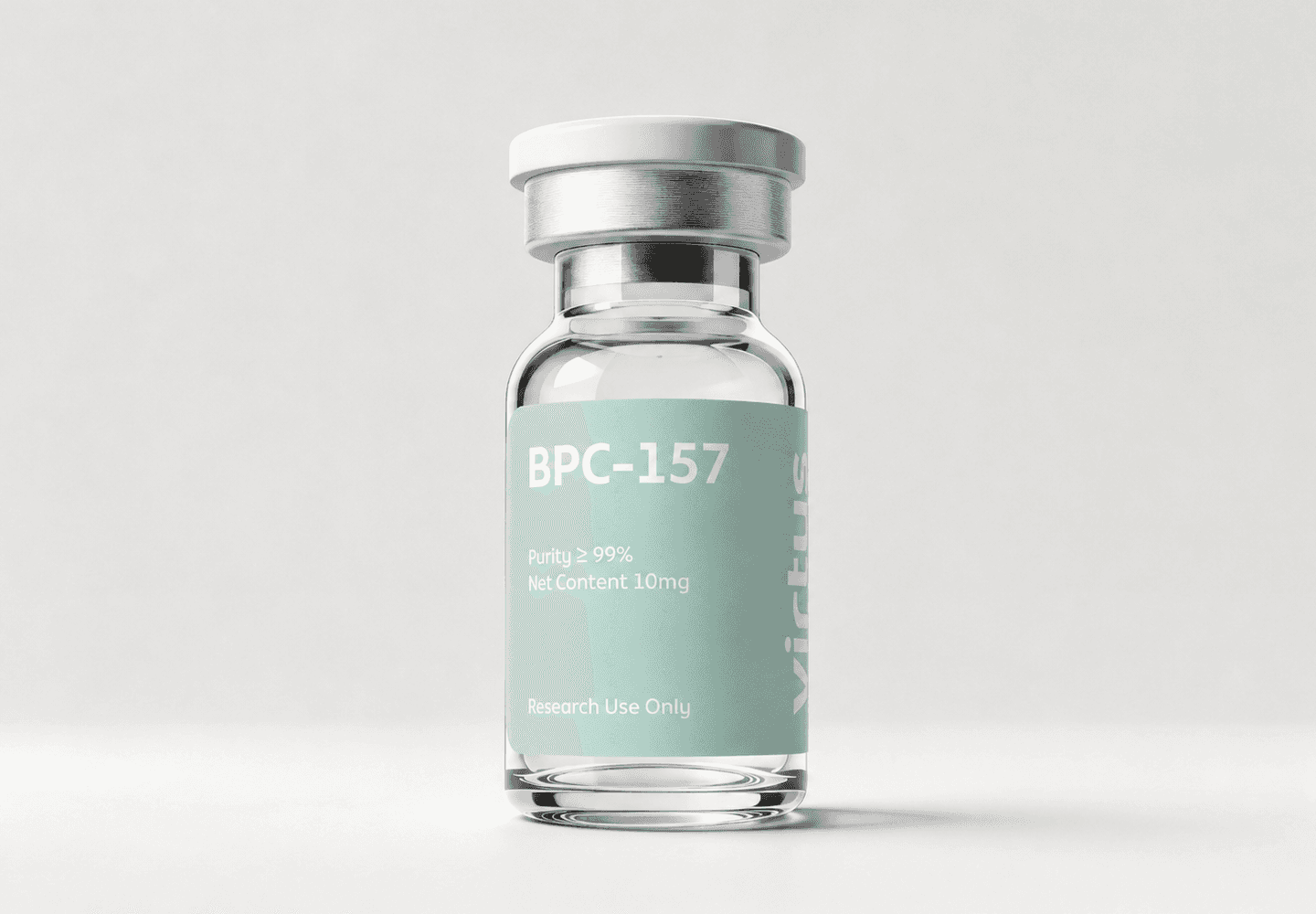
BPC-157
Body Protection Compound‑157
Also referenced as: PL14736 · Body Protection Compound 157 · Gastric Pentadecapeptide BPC 157 · Pentadecapeptide BPC 157
≥99% Release Requirement
Full Panel COA
Free Shipping At $125+
Shipping Protection
Lab Results
| Test | Result | Status |
|---|---|---|
| Purity | – | Pending |
| Quantitation (Avg) | – | Pending |
| Heavy Metals (ICP-MS) | – | Pending |
| Endotoxin (USP <85>) | – | Pending |
| Rapid Microbial Screen | – | Pending |
| Multi Vial Tested | – | Pending |
Curated research on BPC-157
Seiwerth S (2021). Stable Gastric Pentadecapeptide BPC 157 and Wound Healing Front Pharmacol.
PMID: 34267654 →Sikiric P (2020). Stable Gastric Pentadecapeptide BPC 157, Robert's Stomach Cytoprotection/Adaptive Cytoprotection/Organoprotection, and Selye's Stress Coping Response Gut Liver.
PMID: 31158953 →Gwyer D (2019). Gastric pentadecapeptide body protection compound BPC 157 and its role in accelerating musculoskeletal soft tissue healing Cell Tissue Res.
PMID: 30915550 →Sikiric P (2022). Stable Gastric Pentadecapeptide BPC 157 as Useful Cytoprotective Peptide Therapy Biomedicines.
PMID: 36009512 →
About BPC-157
A synthetic pentadecapeptide composed of 15 amino acids investigated extensively in controlled laboratory environments. BPC-157 is among the most studied research peptides in preclinical literature, with published data examining its role in cellular signaling, nitric oxide pathway modulation, cytokine expression, and extracellular matrix interactions.
Research in controlled laboratory models has examined BPC-157 activity across multiple cellular systems including fibroblast signaling, angiogenesis pathway modulation, and inflammatory cytokine regulation at the cellular level. Its stability profile and receptor interaction mechanisms make it a widely referenced compound in tissue-repair research literature.
Also Referenced As
PL14736 · Body Protection Compound 157 · Gastric Pentadecapeptide BPC 157 · Pentadecapeptide BPC 157
Sourced through an established North American supply partner that conducts onsite manufacturer reviews against documented cGMP practices and applicable ISO quality criteria. Virtus Peptides tracks the factory batch number on every lot and catalogues it against independent lab testing, with a final Certificate of Analysis from ILS Laboratories. We pay more to source this way because we hold ourselves to a rigorous, documented standard for the product and for you.
Specifications
- Scientific Name
- Body Protection Compound-157
- CAS Number
- 137525-51-0
- Molecular Formula
- C₆₂H₉₈N₁₆O₂₂
- Molecular Weight
- 1,419.54 g/mol
- Physical Form
- Lyophilized powder
- Purity
- 99%+
- Storage
- −20°C, protected from light
Storage & Handling
Store per the product label and available manufacturer handling documentation, and follow standard laboratory protocols for handling.
Storage
Store the lyophilized powder at −20°C in a standard laboratory freezer, protected from light, moisture, and heat. Avoid repeated freeze-thaw cycles.
Shelf Life
Per the manufacturer, the lyophilized powder remains stable for 12–24 months when stored frozen in its original sealed vial. Our release testing verifies identity, purity, content, and the contaminant panels and does not itself establish shelf life.
Mechanism & Research Background
BPC-157 (Body Protection Compound 157) is a synthetic 15-amino acid peptide whose sequence corresponds to a fragment of a larger protein originally isolated from human gastric juice. Identified in early research literature under the developmental code PL14736, BPC-157 has accumulated one of the most extensive preclinical research corpora of any synthetic peptide on PubMed, with over 100 published papers spanning more than two decades. Its 15-residue sequence (Gly-Glu-Pro-Pro-Pro-Gly-Lys-Pro-Ala-Asp-Asp-Ala-Gly-Leu-Val) gives the peptide notable stability in research model systems, including reported resistance to proteolytic degradation in gastric-acid-mimicking environments.
In pathway research, BPC-157 has been examined across multiple cellular systems, most prominently angiogenesis pathway markers, nitric oxide signaling, cytokine expression, and fibroblast biology in preclinical literature. Foundational mechanistic work by Sikiric, Seiwerth, and colleagues has characterized BPC-157 activity in laboratory models examining endothelial cell behavior, growth factor expression, and inflammatory cytokine modulation (Sikiric et al., Gut Liver, 2020; Seiwerth et al., Front Pharmacol, 2021). Distinct from peptides that act through a single canonical receptor, BPC-157's research literature describes a multi-pathway interaction profile under active investigation.
Studied effects in research models include modulation of nitric oxide synthase expression, vascular endothelial growth factor pathway markers, and cellular markers associated with extracellular matrix turnover and tissue repair (Gwyer et al., Cell Tissue Res, 2019). BPC-157 remains one of the most heavily referenced compounds in tissue-repair research literature; products supplied by Virtus Peptides are for in vitro laboratory research use only, not for human or veterinary use, not for diagnostic, therapeutic, or clinical use, and not intended for consumption or administration.
Frequently Researched Questions
What is BPC-157?
BPC-157 (Body Protection Compound 157) is a synthetic 15-amino acid peptide whose sequence corresponds to a fragment of a protein originally identified in human gastric juice. It is referenced in research literature under the developmental code PL14736 and has accumulated extensive peer-reviewed preclinical research on PubMed. Virtus Peptides supplies BPC-157 as a lyophilized powder strictly for in-vitro laboratory research.
What is the amino acid sequence of BPC-157?
BPC-157 is a 15-amino acid pentadecapeptide with the sequence Gly-Glu-Pro-Pro-Pro-Gly-Lys-Pro-Ala-Asp-Asp-Ala-Gly-Leu-Val. The "157" in the name refers to the residue position within the larger Body Protection Compound source protein from which the fragment was identified.
What is BPC-157's molecular weight?
BPC-157 has a molecular weight of approximately 1,419.54 g/mol with the molecular formula C₆₂H₉₈N₁₆O₂₂.
What does PL14736 mean?
PL14736 is the developmental code under which BPC-157 was investigated in early preclinical research literature. The two terms refer to the same peptide and both appear in PubMed search results.
What testing does Virtus Peptides run on BPC-157?
Every batch of Virtus Peptides BPC-157 is independently tested by ILS Laboratories (ISO/IEC 17025 accredited) across the full QC panel: purity and quantitation by HPLC, heavy metals by ICP-MS (lead, arsenic, cadmium, chromium, and mercury), bacterial endotoxin by USP <85>, and a rapid microbial screen (DNA microarray). Three vials provide the material required for the complete ILS quality control panel, and two additional vials are each tested for HPLC purity, identity, and net peptide content to evaluate conformity. The full Certificate of Analysis is published in our COA database before any vial ships.
What is the recommended storage temperature for BPC-157?
Lyophilized BPC-157 should be stored at −20°C, protected from light, in the original sealed vial. Repeated freeze-thaw cycles should be avoided. Per the manufacturer, the sealed lyophilized material has a stated frozen storage period of 12 to 24 months. Virtus Peptides release testing does not independently establish product shelf life.
Where can I find published research on BPC-157?
BPC-157 is one of the most heavily indexed peptides on PubMed with over 100 peer-reviewed papers. Search "BPC-157", "PL14736", or "gastric pentadecapeptide". Foundational mechanistic work by Sikiric, Seiwerth, and colleagues spans more than two decades of preclinical research literature.