
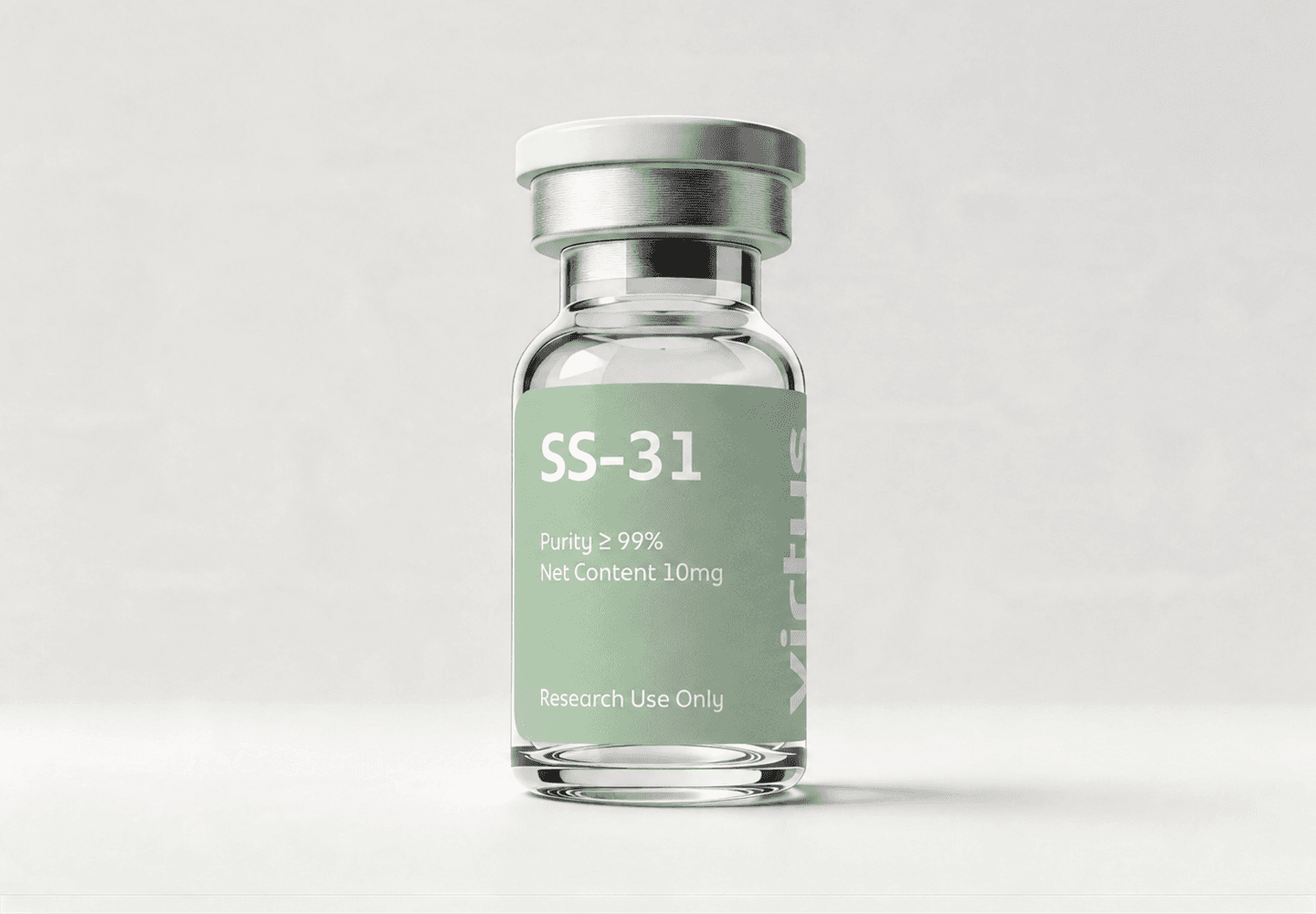
SS-31
Elamipretide · Mitochondria‑Targeted Tetrapeptide
Also referenced as: Elamipretide · MTP-131 · Bendavia · Szeto-Schiller Peptide 31 · D-Arg-Dmt-Lys-Phe-NH₂
≥99% Release Requirement
Full Panel COA
Free Shipping At $125+
Shipping Protection
Lab Results
| Test | Result | Status |
|---|---|---|
| Purity | – | Pending |
| Quantitation (Avg) | – | Pending |
| Heavy Metals (ICP-MS) | – | Pending |
| Endotoxin (USP <85>) | – | Pending |
| Rapid Microbial Screen | – | Pending |
| Multi Vial Tested | – | Pending |
Curated research on SS-31
Birk AV (2013). The mitochondrial-targeted compound SS-31 re-energizes ischemic mitochondria by interacting with cardiolipin J Am Soc Nephrol.
PMID: 23813215 →Szeto HH (2014). First-in-class cardiolipin-protective compound as a therapeutic agent to restore mitochondrial bioenergetics Br J Pharmacol.
PMID: 24117165 →Chavez JD (2020). Mitochondrial protein interaction landscape of SS-31 Proc Natl Acad Sci U S A.
PMID: 32554501 →Campbell MD (2019). Improving mitochondrial function with SS-31 reverses age-related redox stress and improves exercise tolerance in aged mice Free Radic Biol Med.
PMID: 30597195 →
About SS-31
A synthetic mitochondria-targeted tetrapeptide with the sequence D-Arg-Dmt-Lys-Phe-NH₂. SS-31 is investigated in preclinical research for its interaction with cardiolipin on the inner mitochondrial membrane and for its role in mitochondrial bioenergetics, electron transport organization, and cellular redox balance.
Named for Hazel Szeto and Peter Schiller, who characterized the aromatic-cationic peptide series it belongs to, SS-31 is also referenced in published research as elamipretide, MTP-131, and Bendavia. Research has examined its effects on cristae structure and ATP synthesis in ischemic tissue models, and on redox stress and physical-capacity endpoints in aged animal models.
Also Referenced As
Elamipretide · MTP-131 · Bendavia · Szeto-Schiller Peptide 31 · D-Arg-Dmt-Lys-Phe-NH₂
Sourced through an established North American supply partner that conducts onsite manufacturer reviews against documented cGMP practices and applicable ISO quality criteria. Virtus Peptides tracks the factory batch number on every lot and catalogues it against independent lab testing, with a final Certificate of Analysis from ILS Laboratories. We pay more to source this way because we hold ourselves to a rigorous, documented standard for the product and for you.
Specifications
- Scientific Name
- D-Arg-Dmt-Lys-Phe-NH₂ (Elamipretide)
- CAS Number
- 736992-21-5
- Molecular Formula
- C₃₂H₄₉N₉O₅
- Molecular Weight
- 639.8 g/mol
- Physical Form
- Lyophilized powder
- Purity
- Coming Soon
- Storage
- −20°C, protected from light, avoid repeated freeze-thaw cycles
Storage & Handling
Store per the product label and available manufacturer handling documentation, and follow standard laboratory protocols for handling.
Storage
Store the lyophilized powder at −20°C in a standard laboratory freezer, protected from light, moisture, and heat. Avoid repeated freeze-thaw cycles.
Shelf Life
Per the manufacturer, the lyophilized powder remains stable for 12–24 months when stored frozen in its original sealed vial. Our release testing verifies identity, purity, content, and the contaminant panels and does not itself establish shelf life.
Mechanism & Research Background
SS-31 is a synthetic tetrapeptide with the sequence D-Arg-Dmt-Lys-Phe-NH₂, built on an alternating aromatic-cationic motif that allows it to cross cell membranes and concentrate in the inner mitochondrial membrane. It was first characterized by Hazel Szeto and Peter Schiller, whose initials give the compound its SS designation, and it appears in published research under the names elamipretide, MTP-131, and Bendavia. Unlike antioxidant compounds that rely on mitochondrial membrane potential to accumulate, SS-31 has been described in the literature as associating with the inner membrane independently of that gradient.
In preclinical research models, SS-31 has been characterized as binding cardiolipin, the signature phospholipid of the inner mitochondrial membrane. Published work has examined how that association affects the cardiolipin-cytochrome c complex, with reported effects on cristae curvature, electron transport chain and supercomplex organization, and the balance between cytochrome c acting as an electron carrier and as a peroxidase. Chemical cross-linking mass spectrometry has since mapped a broader set of mitochondrial protein interactions associated with the peptide, including components of oxidative phosphorylation and 2-oxoglutarate metabolism.
Studied effects in the research literature include mitochondrial bioenergetic endpoints such as ATP synthesis and reactive oxygen species production in ischemic tissue models, alongside redox stress and exercise-capacity measures in aged animal research. SS-31 remains under active investigation across preclinical and clinical research programs; products supplied by Virtus Peptides are for in vitro laboratory research use only, not for human or veterinary use, not for diagnostic, therapeutic, or clinical use, and not intended for consumption or administration.
Frequently Researched Questions
What is SS-31?
SS-31 is a synthetic mitochondria-targeted tetrapeptide with the sequence D-Arg-Dmt-Lys-Phe-NH₂, named for Hazel Szeto and Peter Schiller, who characterized the aromatic-cationic peptide series it belongs to. It is also referenced in published research as elamipretide, MTP-131, and Bendavia, and it has accumulated a substantial peer-reviewed literature on cardiolipin binding and mitochondrial bioenergetics. Virtus Peptides supplies SS-31 as a lyophilized powder strictly for in-vitro laboratory research.
What is the difference between SS-31 and elamipretide?
They are the same molecule under different names. SS-31 is the original laboratory designation from the Szeto-Schiller aromatic-cationic peptide series, while elamipretide is the assigned international nonproprietary name. The same compound also appears in published research as MTP-131 and Bendavia. Literature searches under any of these names return work on the identical D-Arg-Dmt-Lys-Phe-NH₂ tetrapeptide.
What is SS-31's molecular weight?
SS-31 has a molecular weight of approximately 639.8 g/mol with the molecular formula C₃₂H₄₉N₉O₅ (CAS 736992-21-5). Its sequence is D-Arg-Dmt-Lys-Phe-NH₂, where Dmt denotes 2,6-dimethyltyrosine. These figures describe the free base; salt forms of the peptide carry a higher formula weight.
What is cardiolipin and why is it central to SS-31 research?
Cardiolipin is a four-tailed phospholipid found almost exclusively in the inner mitochondrial membrane, where it helps shape cristae folds and holds electron transport chain complexes in position. Published research has characterized SS-31 as binding cardiolipin selectively, and has examined how that association affects the cardiolipin-cytochrome c interaction, cristae curvature, and electron transport efficiency in isolated mitochondria and tissue research models.
What research pathways have been studied with SS-31?
Published preclinical research has examined SS-31 in relation to cardiolipin binding on the inner mitochondrial membrane, cristae architecture, electron transport chain and supercomplex organization, ATP synthesis, and mitochondrial reactive oxygen species production. Cross-linking mass spectrometry work has mapped its broader mitochondrial protein interaction landscape, and aged-animal studies have characterized redox stress and exercise-capacity endpoints.
What testing does Virtus Peptides run on SS-31?
Every batch of Virtus Peptides SS-31 is independently tested by ILS Laboratories (ISO/IEC 17025 accredited) across the full QC panel: purity and quantitation by HPLC, heavy metals by ICP-MS, bacterial endotoxin, and a rapid microbial screen. Three vials provide the material for the complete ILS quality control panel, and two more are each tested for HPLC purity, identity, and net peptide content to evaluate conformity. The full Certificate of Analysis is published in our COA database before any vial ships.
What is the recommended storage temperature for SS-31?
Lyophilized SS-31 should be stored at −20°C, protected from light, in the original sealed vial. Repeated freeze-thaw cycles should be avoided. Virtus Peptides release testing does not independently establish product shelf life.