
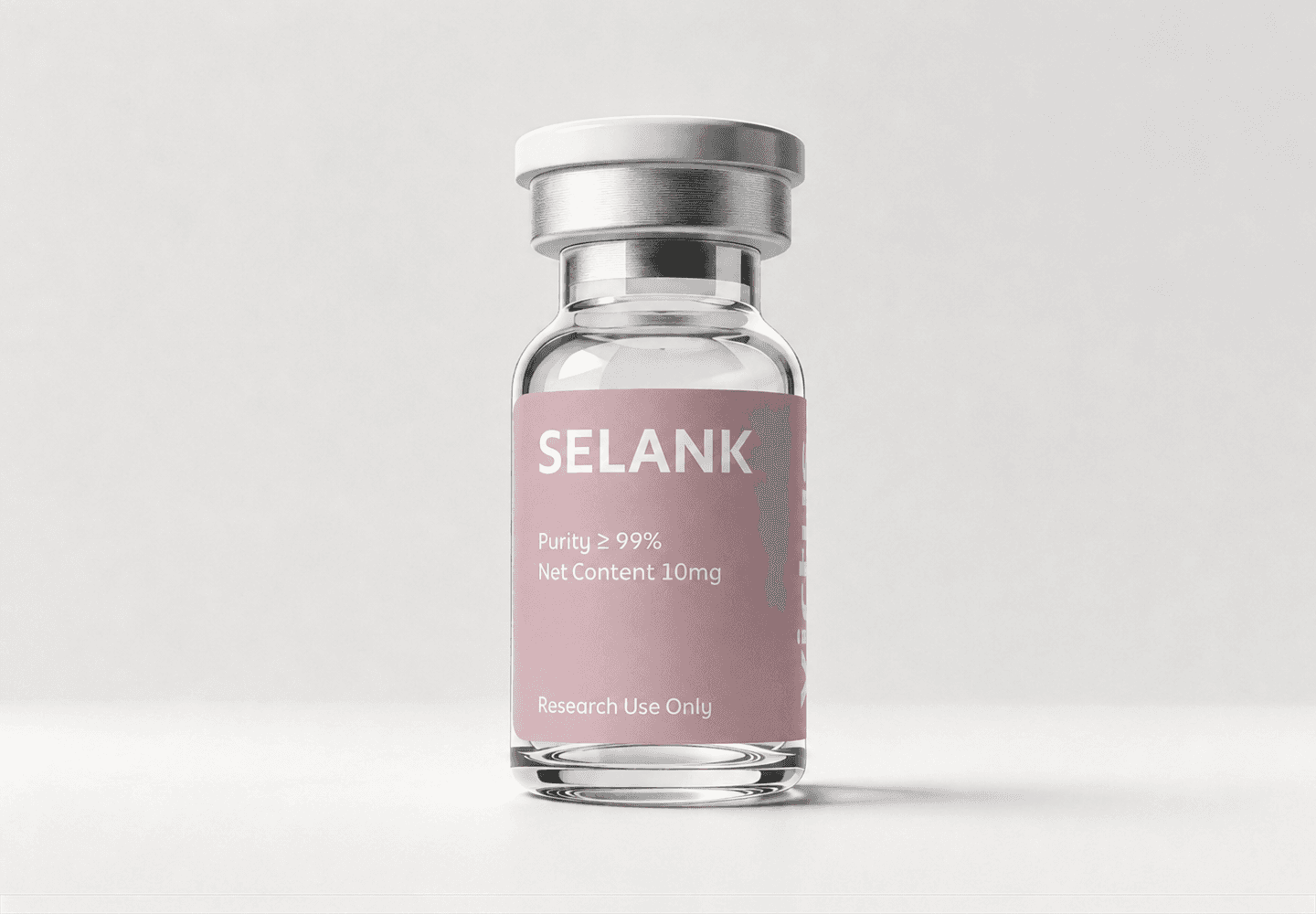
Selank
Tuftsin‑Derived Heptapeptide Analog
Also referenced as: Selank · TP-7 · Thr-Lys-Pro-Arg-Pro-Gly-Pro · TKPRPGP
≥99% Release Requirement
Full Panel COA
Free Shipping At $125+
Shipping Protection
Lab Results
| Test | Result | Status |
|---|---|---|
| Purity | – | Pending |
| Quantitation (Avg) | – | Pending |
| Heavy Metals (ICP-MS) | – | Pending |
| Endotoxin (USP <85>) | – | Pending |
| Rapid Microbial Screen | – | Pending |
| Multi Vial Tested | – | Pending |
Curated research on Selank
Zozulya AA (2001). The inhibitory effect of Selank on enkephalin-degrading enzymes as a possible mechanism of its anxiolytic activity Bull Exp Biol Med.
PMID: 11550013 →Volkova A (2016). Selank Administration Affects the Expression of Some Genes Involved in GABAergic Neurotransmission Front Pharmacol.
PMID: 26924987 →Kolomin T (2011). Expression of inflammation-related genes in mouse spleen under tuftsin analog Selank Regul Pept.
PMID: 21609736 →Kozlovskii II (2003). The optimizing action of the synthetic peptide Selank on a conditioned active avoidance reflex in rats Neurosci Behav Physiol.
PMID: 14552529 →
About Selank
A synthetic heptapeptide derived from the endogenous tetrapeptide tuftsin, extended at the C-terminus with a Pro-Gly-Pro sequence that slows enzymatic breakdown. Selank is investigated in preclinical research for its role in GABAergic signaling, anxiety-related behavioral models, and neuroimmune regulation at the cellular level.
First developed at the Institute of Molecular Genetics of the Russian Academy of Sciences, Selank has been examined in published research as an inhibitor of enkephalin-degrading enzymes and as a regulator of genes involved in GABAergic neurotransmission, with studied effects on anxiety-related behavior, conditioned learning tasks, and inflammatory gene expression in research models.
Also Referenced As
Selank · TP-7 · Thr-Lys-Pro-Arg-Pro-Gly-Pro · TKPRPGP
Sourced through an established North American supply partner that conducts onsite manufacturer reviews against documented cGMP practices and applicable ISO quality criteria. Virtus Peptides tracks the factory batch number on every lot and catalogues it against independent lab testing, with a final Certificate of Analysis from ILS Laboratories. We pay more to source this way because we hold ourselves to a rigorous, documented standard for the product and for you.
Specifications
- Scientific Name
- Thr-Lys-Pro-Arg-Pro-Gly-Pro (Tuftsin Analog)
- CAS Number
- 129954-34-3
- Molecular Formula
- C₃₃H₅₇N₁₁O₉
- Molecular Weight
- 751.9 g/mol
- Physical Form
- Lyophilized powder
- Purity
- Coming Soon
- Storage
- −20°C, protected from light, avoid repeated freeze-thaw cycles
Storage & Handling
Store per the product label and available manufacturer handling documentation, and follow standard laboratory protocols for handling.
Storage
Store the lyophilized powder at −20°C in a standard laboratory freezer, protected from light, moisture, and heat. Avoid repeated freeze-thaw cycles.
Shelf Life
Per the manufacturer, the lyophilized powder remains stable for 12–24 months when stored frozen in its original sealed vial. Our release testing verifies identity, purity, content, and the contaminant panels and does not itself establish shelf life.
Mechanism & Research Background
Selank is a synthetic heptapeptide with the sequence Thr-Lys-Pro-Arg-Pro-Gly-Pro, based on the endogenous immunomodulatory tetrapeptide tuftsin with a C-terminal Pro-Gly-Pro tripeptide added to resist enzymatic degradation. Tuftsin is a fragment released from the immunoglobulin G heavy chain, and the added glyproline extension is the same stabilizing motif carried by Semax, developed in the same research program.
In preclinical research models, Selank has been examined for its inhibition of enkephalin-degrading enzymes in serum, an effect published work has proposed as a mechanism underlying the anxiety-related activity observed in animal studies. Separate gene-expression research has characterized changes in transcripts tied to GABAergic neurotransmission, including GABA-A receptor subunits and GABA transporters, in brain tissue and in cultured neuronal cell lines.
Studied effects in research literature include modulation of anxiety-related and conditioned-avoidance endpoints in rodent models, changes in monoamine and neurotrophic markers, and shifts in the expression of inflammation-related genes consistent with the immunomodulatory lineage of the parent tuftsin molecule. Selank remains a research-stage molecule under active investigation; products supplied by Virtus Peptides are for in vitro laboratory research use only, not for human or veterinary use, not for diagnostic, therapeutic, or clinical use, and not intended for consumption or administration.
Frequently Researched Questions
What is Selank?
Selank is a synthetic heptapeptide derived from tuftsin, an endogenous immunomodulatory tetrapeptide, extended at the C-terminus with a Pro-Gly-Pro sequence that resists enzymatic breakdown. First developed at the Institute of Molecular Genetics of the Russian Academy of Sciences, it has accumulated peer-reviewed preclinical research on GABAergic signaling and neuroimmune regulation. Virtus Peptides supplies Selank as a lyophilized powder strictly for in-vitro laboratory research.
What is the difference between Selank and tuftsin?
Selank is built on tuftsin, the endogenous tetrapeptide Thr-Lys-Pro-Arg released from the immunoglobulin G heavy chain, but unlike the parent tetrapeptide it carries a C-terminal Pro-Gly-Pro tripeptide that slows enzymatic degradation. That extension shifts the studied activity of the molecule in research models toward central GABAergic and monoaminergic pathways alongside the immunomodulatory profile associated with tuftsin. Semax, developed in the same research program, carries the same Pro-Gly-Pro stabilizing motif on a different parent fragment.
What is Selank's molecular weight?
Selank has a molecular weight of approximately 751.9 g/mol with the molecular formula C₃₃H₅₇N₁₁O₉ (CAS 129954-34-3). Its amino-acid sequence is Thr-Lys-Pro-Arg-Pro-Gly-Pro (TKPRPGP).
What research pathways have been studied with Selank?
Published preclinical research has examined Selank in relation to the inhibition of enkephalin-degrading enzymes in serum, the expression of genes involved in GABAergic neurotransmission, and monoamine and neurotrophic markers in brain tissue. Additional work has characterized its effects on inflammation-related gene expression in spleen and immune-cell models, reflecting the immunomodulatory lineage of the tuftsin fragment it is built on.
What testing does Virtus Peptides run on Selank?
Every batch of Virtus Peptides Selank is independently tested by ILS Laboratories (ISO/IEC 17025 accredited) across the full QC panel: purity and quantitation by HPLC, heavy metals by ICP-MS, bacterial endotoxin, and a rapid microbial screen. Three vials provide the material for the complete ILS quality control panel, and two more are each tested for HPLC purity, identity, and net peptide content to evaluate conformity. The full Certificate of Analysis is published in our COA database before any vial ships.
What is the recommended storage temperature for Selank?
Lyophilized Selank should be stored at −20°C, protected from light, in the original sealed vial. Repeated freeze-thaw cycles should be avoided. Virtus Peptides release testing does not independently establish product shelf life.