
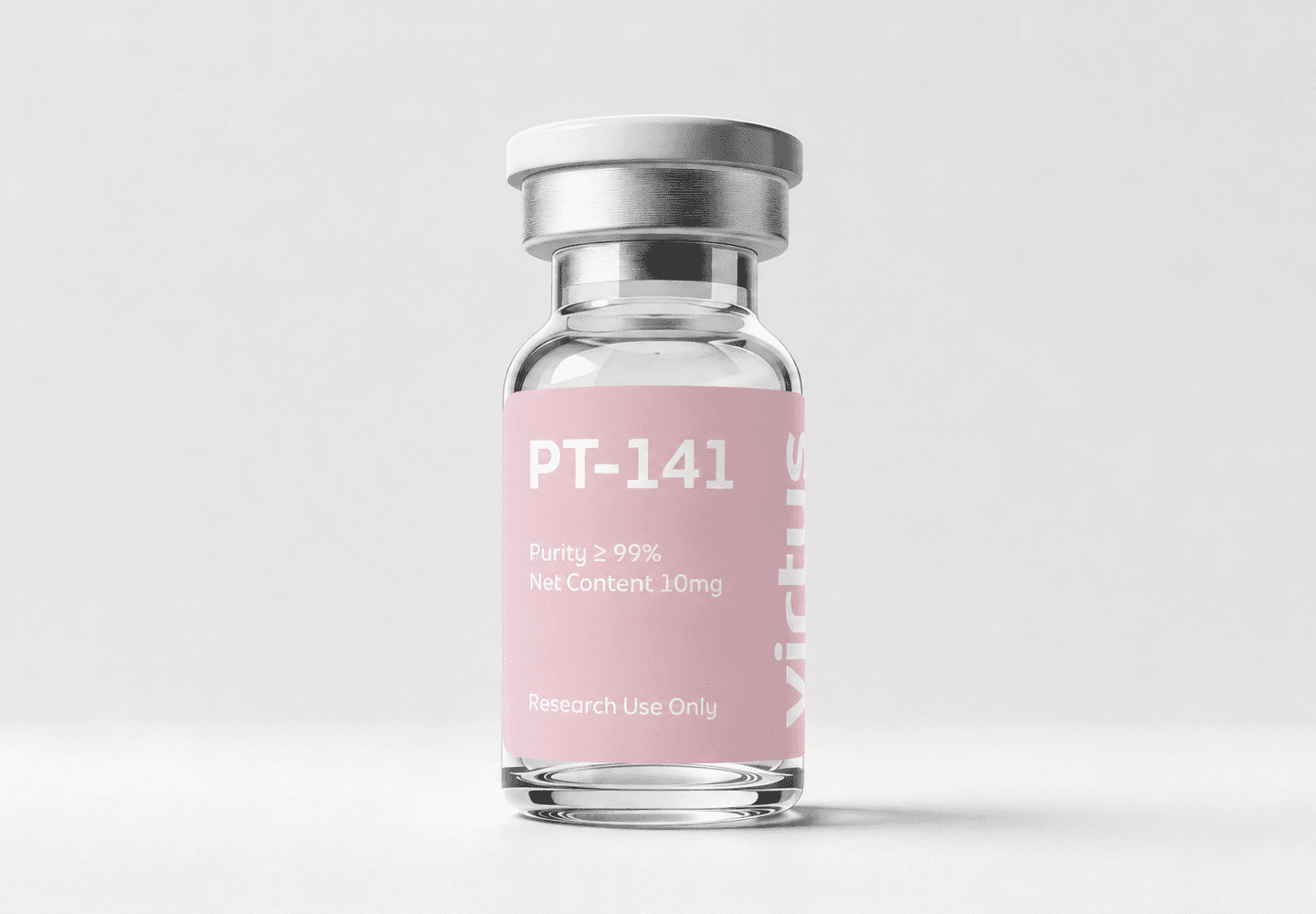
PT-141
Melanocortin Receptor Agonist Peptide
Also referenced as: Bremelanotide · PT-141 · Ac-Nle-cyclo[Asp-His-D-Phe-Arg-Trp-Lys]-OH · Melanocortin Receptor Agonist
≥99% Release Requirement
Full Panel COA
Free Shipping At $125+
Shipping Protection
Lab Results
| Test | Result | Status |
|---|---|---|
| Purity | – | Pending |
| Quantitation (Avg) | – | Pending |
| Heavy Metals (ICP-MS) | – | Pending |
| Endotoxin (USP <85>) | – | Pending |
| Rapid Microbial Screen | – | Pending |
| Multi Vial Tested | – | Pending |
Curated research on PT-141
Molinoff PB (2003). PT-141: a melanocortin agonist for the treatment of sexual dysfunction Ann N Y Acad Sci.
PMID: 12851303 →Diamond LE (2006). An effect on the subjective sexual response in premenopausal women with sexual arousal disorder by bremelanotide (PT-141), a melanocortin receptor agonist J Sex Med.
PMID: 16839319 →
About PT-141
A cyclic heptapeptide analogue of α-melanocyte-stimulating hormone (α-MSH) investigated in preclinical research as a non-selective melanocortin receptor agonist. PT-141 is studied in receptor-pharmacology and animal-model work for its engagement of the melanocortin system, principally MC4R and MC3R, and the central signaling pathways associated with those receptors.
Derived from the melanotan II scaffold with a D-Phe substitution and an Asp–Lys lactam bridge that confer metabolic stability in laboratory assays, PT-141 (bremelanotide) is examined in published literature as a tool compound for probing melanocortin receptor selectivity, cAMP / Gs signaling, and hypothalamic melanocortin circuitry at the cellular level.
Also Referenced As
Bremelanotide · PT-141 · Ac-Nle-cyclo[Asp-His-D-Phe-Arg-Trp-Lys]-OH · Melanocortin Receptor Agonist
Sourced through an established North American supply partner that conducts onsite manufacturer reviews against documented cGMP practices and applicable ISO quality criteria. Virtus Peptides tracks the factory batch number on every lot and catalogues it against independent lab testing, with a final Certificate of Analysis from ILS Laboratories. We pay more to source this way because we hold ourselves to a rigorous, documented standard for the product and for you.
Specifications
- Scientific Name
- PT-141: Bremelanotide (Melanocortin Receptor Agonist)
- CAS Number
- 189691-06-3
- Molecular Formula
- C₅₀H₆₈N₁₄O₁₀
- Molecular Weight
- 1,025.2 g/mol
- Physical Form
- Lyophilized powder
- Purity
- Coming Soon
- Storage
- −20°C, protected from light, avoid repeated freeze-thaw cycles
Storage & Handling
Store per the product label and available manufacturer handling documentation, and follow standard laboratory protocols for handling.
Storage
Store the lyophilized powder at −20°C in a standard laboratory freezer, protected from light, moisture, and heat. Avoid repeated freeze-thaw cycles.
Shelf Life
Per the manufacturer, the lyophilized powder remains stable for 12–24 months when stored frozen in its original sealed vial. Our release testing verifies identity, purity, content, and the contaminant panels and does not itself establish shelf life.
Mechanism & Research Background
PT-141 (bremelanotide) is a synthetic cyclic heptapeptide analogue of α-MSH with the structure Ac-Nle-cyclo[Asp-His-D-Phe-Arg-Trp-Lys]-OH. In receptor-binding studies it behaves as a non-selective melanocortin receptor agonist, with highest reported affinity for MC4R and MC3R, intermediate activity at MC1R, and negligible activity at MC5R and MC2R. The D-Phe substitution and Asp–Lys lactam bridge are described in the literature as conferring resistance to enzymatic degradation in preclinical assays.
In cell-culture systems, melanocortin receptor engagement by PT-141 couples to Gs / adenylyl-cyclase / cAMP signaling, with Gq-linked phospholipase-C / Ca²⁺ and ERK / MAPK cascades also reported for MC4R. Published research uses the peptide as a reference melanocortin ligand for receptor-selectivity and signaling-pathway profiling, and as a centrally acting probe of hypothalamic melanocortin circuitry in animal models, distinct from peripheral vascular mechanisms.
MC4R is documented in rodent models as a regulator of energy homeostasis and appetite / satiety signaling, and PT-141 has been studied in this context as a melanocortin-pathway tool compound. The peptide is reported in preclinical literature to cross the blood–brain barrier, which has made it of interest for distinguishing central from peripheral melanocortin signaling. PT-141 remains a research-stage molecule; products supplied by Virtus Peptides are for in vitro laboratory research use only, not for human or veterinary use, not for diagnostic, therapeutic, or clinical use, and not intended for consumption or administration.