
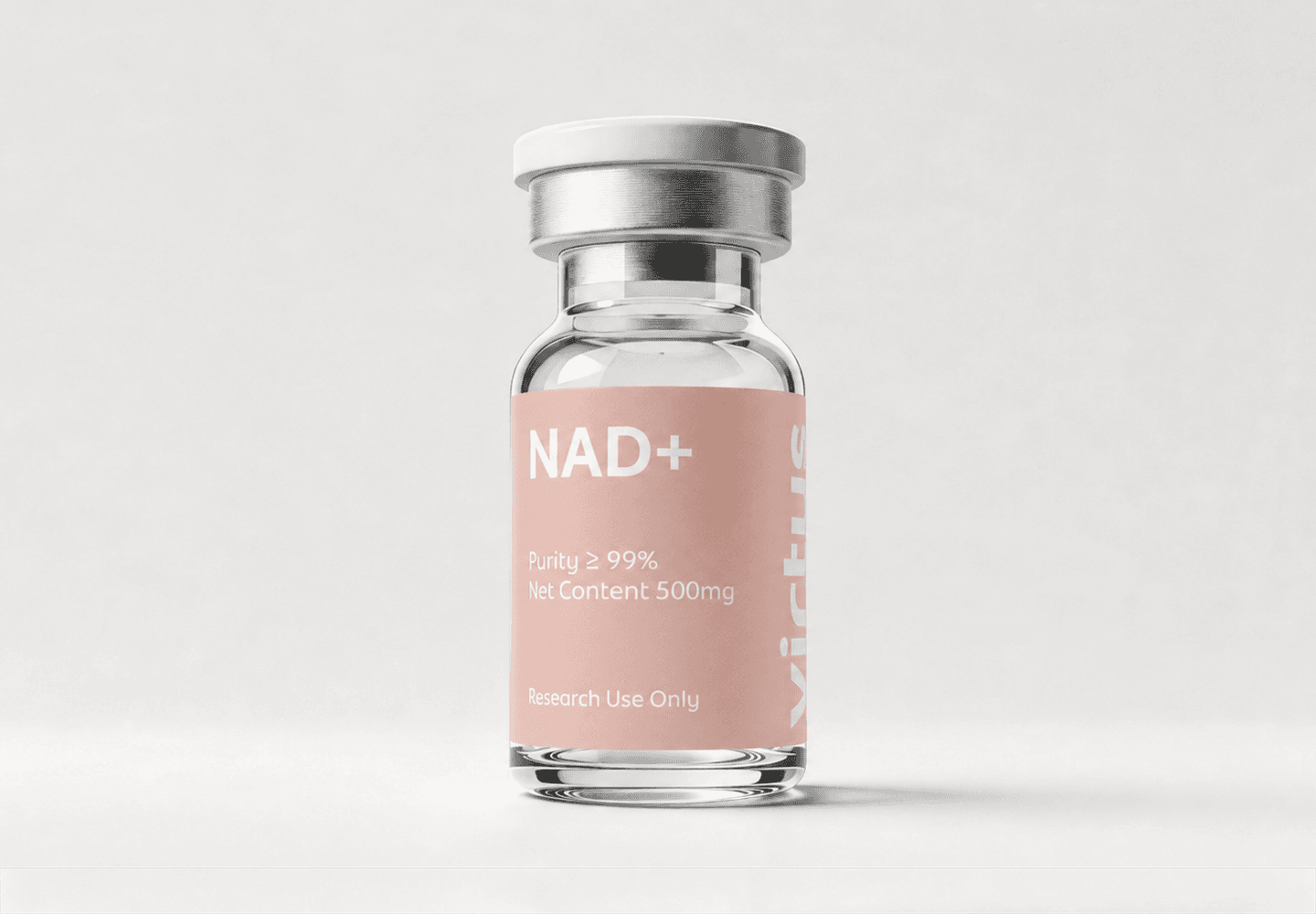
NAD+
Nicotinamide Adenine Dinucleotide
Also referenced as: NAD+ · β-NAD · Nadide · Coenzyme I · Diphosphopyridine Nucleotide (DPN) · Cozymase
≥99% Release Requirement
Full Panel COA
Free Shipping At $125+
Shipping Protection
Lab Results
| Test | Result | Status |
|---|---|---|
| Purity | – | Pending |
| Quantitation (Avg) | – | Pending |
| Heavy Metals (ICP-MS) | – | Pending |
| Endotoxin (USP <85>) | – | Pending |
| Rapid Microbial Screen | – | Pending |
| Multi Vial Tested | – | Pending |
Curated research on NAD+
Verdin E (2015). NAD⁺ in aging, metabolism, and neurodegeneration Science.
PMID: 26785480 →Cantó C (2015). NAD(+) Metabolism and the Control of Energy Homeostasis: A Balancing Act between Mitochondria and the Nucleus Cell Metab.
PMID: 26118927 →Gomes AP (2013). Declining NAD(+) induces a pseudohypoxic state disrupting nuclear-mitochondrial communication during aging Cell.
PMID: 24360282 →Covarrubias AJ (2021). NAD(+) metabolism and its roles in cellular processes during ageing Nat Rev Mol Cell Biol.
PMID: 33353981 →
About NAD+
A naturally occurring pyridine dinucleotide coenzyme present in every living cell, composed of a nicotinamide nucleotide joined to an adenine nucleotide through a pyrophosphate bridge. NAD+ is investigated in preclinical research for its role as the central electron carrier of cellular redox metabolism and as the consumed cosubstrate of the sirtuin, PARP, and CD38 enzyme families.
NAD+ is a coenzyme rather than a peptide, and it carries no amino-acid sequence. Published research has characterized a gradual decline in tissue and cellular NAD+ levels across multiple model organisms, and has mapped the three routes that replenish the cellular pool: the salvage pathway from nicotinamide, the Preiss-Handler pathway from nicotinic acid, and de novo synthesis from tryptophan. It is one of the most extensively referenced molecules in metabolic, mitochondrial, and longevity research literature.
Also Referenced As
NAD+ · β-NAD · Nadide · Coenzyme I · Diphosphopyridine Nucleotide (DPN) · Cozymase
Sourced through an established North American supply partner that conducts onsite manufacturer reviews against documented cGMP practices and applicable ISO quality criteria. Virtus Peptides tracks the factory batch number on every lot and catalogues it against independent lab testing, with a final Certificate of Analysis from ILS Laboratories. We pay more to source this way because we hold ourselves to a rigorous, documented standard for the product and for you.
Specifications
- Scientific Name
- β-Nicotinamide Adenine Dinucleotide (Oxidized Form)
- CAS Number
- 53-84-9
- Molecular Formula
- C₂₁H₂₇N₇O₁₄P₂
- Molecular Weight
- 663.43 g/mol
- Physical Form
- Lyophilized powder
- Purity
- Coming Soon
- Storage
- −20°C, protected from light, avoid repeated freeze-thaw cycles
Storage & Handling
Store per the product label and available manufacturer handling documentation, and follow standard laboratory protocols for handling.
Storage
Store the lyophilized powder at −20°C in a standard laboratory freezer, protected from light, moisture, and heat. Avoid repeated freeze-thaw cycles.
Shelf Life
Per the manufacturer, the lyophilized powder remains stable for 12–24 months when stored frozen in its original sealed vial. Our release testing verifies identity, purity, content, and the contaminant panels and does not itself establish shelf life.
Mechanism & Research Background
NAD+ (β-nicotinamide adenine dinucleotide) is a pyridine dinucleotide coenzyme with the molecular formula C₂₁H₂₇N₇O₁₄P₂ and a molecular weight of approximately 663.43 g/mol. Structurally it joins a nicotinamide riboside 5′-monophosphate unit to an adenosine 5′-monophosphate unit through a pyrophosphate bridge. It is not a peptide and has no amino-acid sequence. The plus sign in the name denotes the permanent positive charge carried by the quaternary nitrogen of the nicotinamide ring, which is balanced internally by a phosphate oxygen rather than reflecting an overall positive charge on the molecule. NAD+ and NADH form a redox couple: the nicotinamide ring accepts a hydride ion to become NADH and releases it to return to NAD+, and that two-electron transfer is the basis of its function as an electron carrier in glycolysis, the tricarboxylic acid cycle, fatty-acid oxidation, and oxidative phosphorylation.
Beyond the redox role, research has characterized NAD+ as a consumed cosubstrate for three non-redox enzyme families. The sirtuins (SIRT1 through SIRT7) are NAD+-dependent deacylases that cleave the molecule to nicotinamide and 2'-O-acyl-ADP-ribose while removing acyl marks from histones and metabolic enzymes. The poly(ADP-ribose) polymerases consume NAD+ to build ADP-ribose polymers at sites of DNA strand breaks. CD38 and its homolog CD157 hydrolyze NAD+ to generate calcium-mobilizing second messengers. Because all three consume rather than recycle the molecule, cellular NAD+ concentration is set by the balance between that consumption and resynthesis, principally through the salvage pathway in which NAMPT converts nicotinamide to nicotinamide mononucleotide and the NMNAT isoforms convert nicotinamide mononucleotide to NAD+. Cantó and colleagues (Cell Metab, 2015) reviewed how this balance links energy status to adaptive responses across the mitochondrial and nuclear compartments.
Studied effects in the research literature center on what happens as that balance shifts with age. Gomes and colleagues (Cell, 2013) described a pseudohypoxic state in aged mice in which declining nuclear NAD+ and the normoxic accumulation of HIF-1α disrupt a PGC-1α/β-independent route of nuclear to mitochondrial communication, with the specific loss of mitochondrially encoded oxidative phosphorylation subunits reported as reversible on raising NAD+ levels in a SIRT1-dependent manner. Verdin (Science, 2015) reviewed the factors regulating NAD+ availability and its intersection with aging, metabolism, and neurodegeneration research endpoints, and Covarrubias and colleagues (Nat Rev Mol Cell Biol, 2021) surveyed the aging literature including the contribution of CD38-driven consumption to NAD+ loss and the influence of NAD+ on DNA repair, chromatin remodeling, cellular senescence, and immune cell function. NAD+ remains a molecule under active investigation across metabolism, mitochondrial biology, and longevity research; products supplied by Virtus Peptides are for in vitro laboratory research use only, not for human or veterinary use, not for diagnostic, therapeutic, or clinical use, and not intended for consumption or administration.
Frequently Researched Questions
What is NAD+?
NAD+ (nicotinamide adenine dinucleotide) is a coenzyme found in all living cells, composed of a nicotinamide nucleotide joined to an adenine nucleotide through a pyrophosphate bridge. It serves both as the electron carrier that fuels reduction-oxidation reactions and as a consumed cosubstrate for enzymes such as the sirtuins and the poly(ADP-ribose) polymerases (Verdin, Science, 2015). Virtus Peptides supplies NAD+ as a lyophilized powder strictly for in-vitro laboratory research.
Is NAD+ a peptide?
No. NAD+ is a dinucleotide coenzyme, not a peptide, and it has no amino-acid sequence. It is built from two nucleotides, one carrying nicotinamide and one carrying adenine, linked through their phosphate groups. It sits alongside research peptides in this catalogue because it is handled the same way at the bench: a lyophilized powder supplied in a sealed vial, stored frozen and protected from light, and reconstituted for in-vitro work.
What is the molecular weight of NAD+?
NAD+ has a molecular weight of approximately 663.43 g/mol with the molecular formula C₂₁H₂₇N₇O₁₄P₂, registered under CAS 53-84-9. The plus sign in the name refers to the permanent positive charge on the quaternary nitrogen of the nicotinamide ring, which is balanced internally by a phosphate oxygen, not to an overall positive charge on the molecule.
What is the difference between NAD+ and NADH?
NAD+ and NADH are the oxidized and reduced members of the same redox couple. The nicotinamide ring of NAD+ accepts a hydride ion to become NADH and releases it to return to NAD+. That two-electron transfer is how the molecule carries electrons through glycolysis, the tricarboxylic acid cycle, fatty-acid oxidation, and the electron transport chain. Research literature commonly reports the NAD+/NADH ratio rather than either species alone, because the ratio is what reflects the redox state of the cell.
How does NAD+ differ from NMN and NR?
NMN (nicotinamide mononucleotide) and NR (nicotinamide riboside) are precursors that cells convert into NAD+ through the salvage pathway, whereas NAD+ is the finished coenzyme itself. The two enter that route at different points: NAMPT converts nicotinamide to nicotinamide mononucleotide, while nicotinamide riboside is phosphorylated to nicotinamide mononucleotide by the nicotinamide riboside kinases (NRK1 and NRK2). From there the NMNAT enzymes convert nicotinamide mononucleotide to NAD+. Comparative research across the precursor molecules and the coenzyme remains an active area of investigation (Covarrubias et al., Nat Rev Mol Cell Biol, 2021).
What research pathways have been studied with NAD+?
Published preclinical research has examined NAD+ across four broad areas: redox metabolism and the NAD+/NADH ratio; NAD+-dependent sirtuin signaling; poly(ADP-ribose) polymerase activity in the DNA-damage response; and CD38-driven NAD+ consumption in aging and inflammation models. The reviews by Cantó et al. (Cell Metab, 2015) and Covarrubias et al. (Nat Rev Mol Cell Biol, 2021) map how these pathways intersect across the mitochondrial and nuclear compartments.
What testing does Virtus Peptides run on NAD+?
Every batch of Virtus Peptides NAD+ is independently tested by ILS Laboratories (ISO/IEC 17025 accredited) across the full QC panel: purity and quantitation by HPLC, heavy metals by ICP-MS (lead, arsenic, cadmium, chromium, and mercury), bacterial endotoxin by USP <85>, and a rapid microbial screen (DNA microarray). Three vials provide the material required for the complete ILS quality control panel, and two additional vials are each tested for HPLC purity, identity, and net content to evaluate conformity. The full Certificate of Analysis is published in our COA database before any vial ships.
What is the recommended storage temperature for NAD+?
Lyophilized NAD+ should be stored at −20°C, protected from light, in the original sealed vial. Repeated freeze-thaw cycles should be avoided. Virtus Peptides release testing does not independently establish product shelf life.
Where can I find published research on NAD+?
PubMed indexes several decades of peer-reviewed research on NAD+ biology. Search "nicotinamide adenine dinucleotide", "NAD+", or the older literature names "coenzyme I" and "diphosphopyridine nucleotide". Useful entry points into the modern corpus include Verdin (Science, 2015), Cantó et al. (Cell Metab, 2015), and Covarrubias et al. (Nat Rev Mol Cell Biol, 2021).