
Stock Inbound
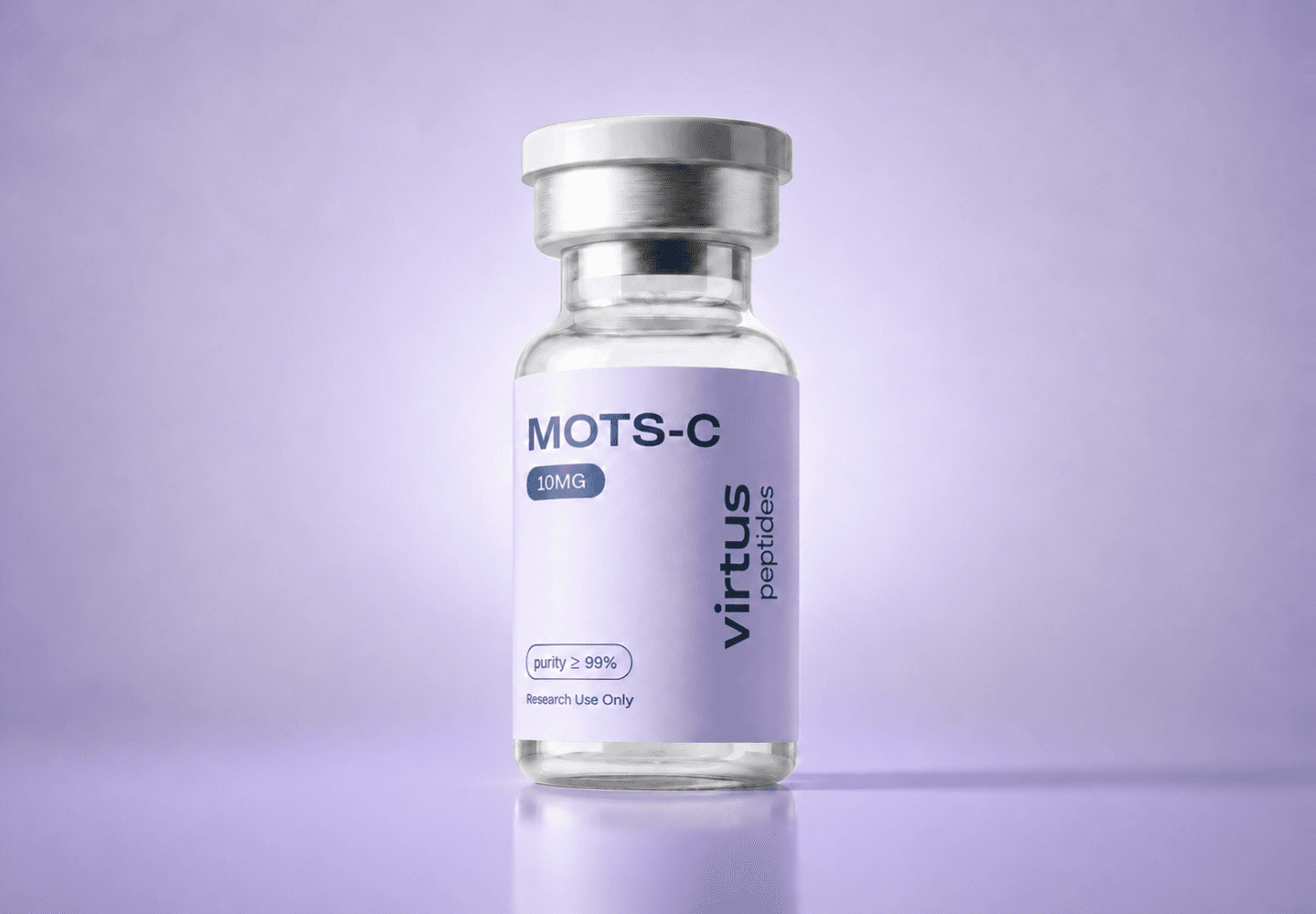
MOTS-C
Mitochondrial‑Derived Metabolic Peptide
Also referenced as: MOTS-c · MOT-C · Mitochondrial Open Reading Frame Of The 12S rRNA-c · MT-RNR1 Encoded Peptide · Mitochondrial-Derived Peptide
≥99% Release Requirement
Full Panel COA
Free Shipping At $200+
Shipping Protection
Lab Results
| Test | Result | Status |
|---|---|---|
| Purity | – | Pending |
| Quantitation (Avg) | – | Pending |
| Heavy Metals (ICP-MS) | – | Pending |
| Endotoxin (USP <85>) | – | Pending |
| Rapid Microbial Screen | – | Pending |
| Multi Vial Tested | – | Pending |
Curated research on MOTS-C
Lee C (2015). The mitochondrial-derived peptide MOTS-c promotes metabolic homeostasis and reduces obesity and insulin resistance Cell Metab.
PMID: 25738459 →Reynolds JC (2021). MOTS-c is an exercise-induced mitochondrial-encoded regulator of age-dependent physical decline and muscle homeostasis Nat Commun.
PMID: 34470889 →
About MOTS-C
A 16-amino-acid mitochondrial-derived peptide (MDP) encoded within the 12S rRNA region of mitochondrial DNA. MOTS-C is investigated in preclinical research for its role in metabolic regulation, insulin sensitivity, glucose homeostasis, and AMPK-dependent signaling at the cellular level.
First characterized by Lee et al. (Cell Metabolism, 2015), MOTS-C represents a class of mitochondrial peptides that signal between mitochondria and the nucleus. Published research has examined its role as an exercise-induced regulator of metabolic homeostasis and physical capacity, with downstream effects on the AMPK / folate-methionine cycle.
Also Referenced As
MOTS-c · MOT-C · Mitochondrial Open Reading Frame Of The 12S rRNA-c · MT-RNR1 Encoded Peptide · Mitochondrial-Derived Peptide
Sourced through an established North American supply partner that conducts onsite manufacturer reviews against documented cGMP practices and applicable ISO quality criteria. Virtus Peptides tracks the factory batch number on every lot and catalogues it against independent lab testing, with a final Certificate of Analysis from ILS Laboratories. We pay more to source this way because we hold ourselves to a rigorous, documented standard for the product and for you.
Specifications
- Scientific Name
- MOTS-c: Mitochondrial Open Reading Frame Of The 12S rRNA-c
- CAS Number
- 1627580-64-6
- Molecular Formula
- C₁₀₁H₁₅₂N₂₈O₂₂S₂
- Molecular Weight
- 2,174.9 g/mol
- Physical Form
- Lyophilized powder
- Purity
- Coming Soon
- Storage
- −20°C, protected from light, avoid repeated freeze-thaw cycles
Storage & Handling
Store per the product label and available manufacturer handling documentation, and follow standard laboratory protocols for handling.
Storage
Store the lyophilized powder at −20°C in a standard laboratory freezer, protected from light, moisture, and heat. Avoid repeated freeze-thaw cycles.
Shelf Life
Per the manufacturer, the lyophilized powder remains stable for 12–24 months when stored frozen in its original sealed vial. Our release testing verifies identity, purity, content, and the contaminant panels and does not itself establish shelf life.
Mechanism & Research Background
MOTS-C is a 16-amino-acid peptide with the sequence MRWQEMGYIFYPRKLR, encoded by the MT-RNR1 gene within the 12S rRNA region of mitochondrial DNA. It is one of a growing class of mitochondrial-derived peptides (MDPs) that act as retrograde signals from the mitochondrion to the rest of the cell. Published research describes MOTS-C as regulating metabolic homeostasis through AMPK activation and the folate-methionine cycle.
In preclinical research models, MOTS-C has been shown to translocate to the nucleus in response to metabolic stress, where it regulates the expression of antioxidant and metabolic response genes. Cellular signaling work has examined its effects on glucose uptake, fatty acid oxidation, and insulin sensitivity across multiple tissue types, particularly skeletal muscle and adipose tissue.
Research in cell and tissue models has examined its modulation of skeletal muscle glucose handling, hepatic lipid metabolism, and adipose tissue function. Phase 0/preclinical literature has examined endpoints relevant to obesity, type 2 diabetes, age-related metabolic decline, and exercise capacity. The peptide remains a research-stage molecule under active investigation; products supplied by Virtus Peptides are for in vitro laboratory research use only, not for human or veterinary use, not for diagnostic, therapeutic, or clinical use, and not intended for consumption or administration.