
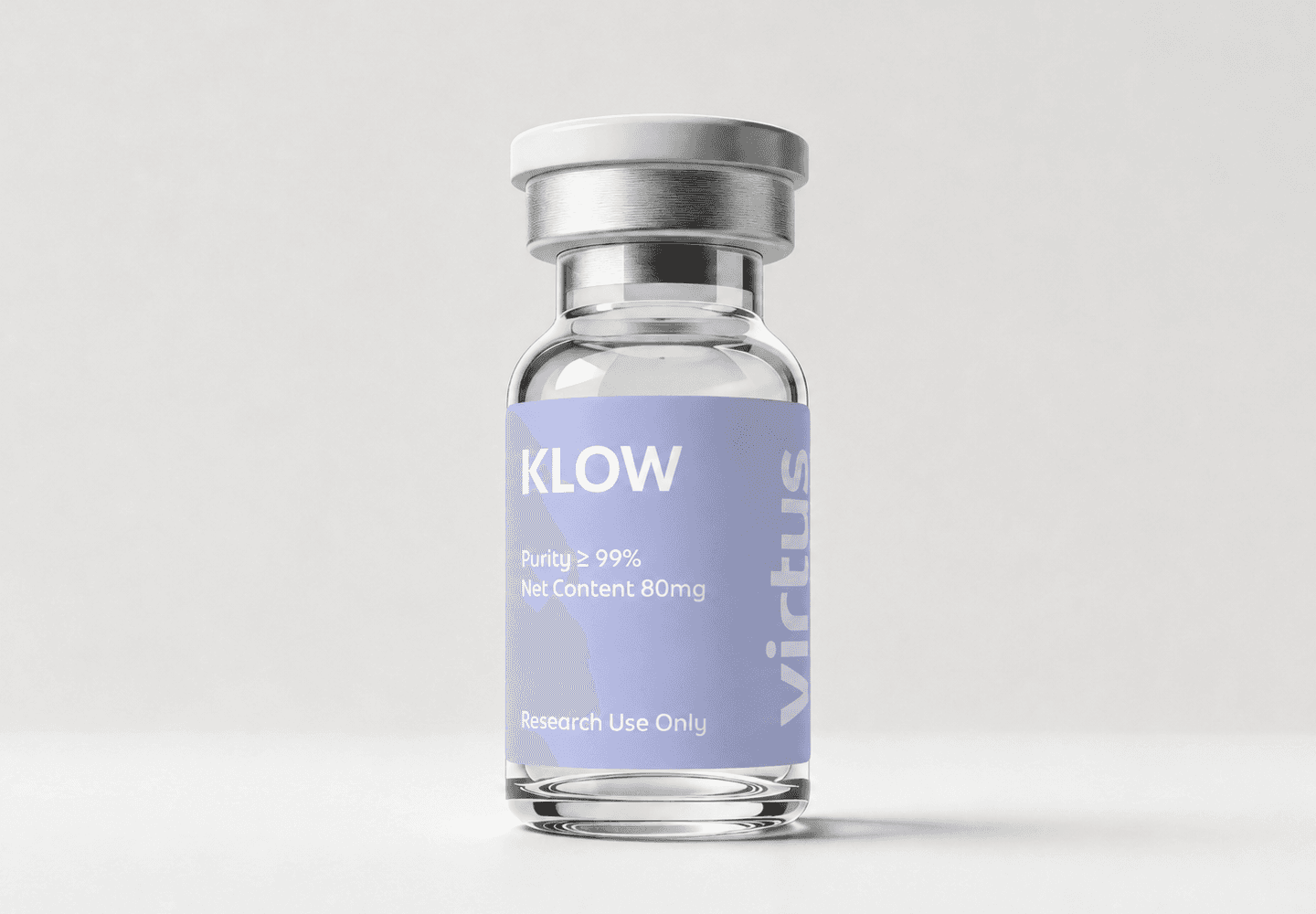
KLOW
KPV + GHK‑Cu + BPC‑157 + TB‑500 Research Blend
Also referenced as: KPV + GHK-Cu + BPC-157 + TB-500 Blend · Four-Component Peptide Blend · Multi-pathway Research Peptide Stack
≥99% Release Requirement
Full Panel COA
Free Shipping At $125+
Shipping Protection
Lab Results
| Test | Result | Status |
|---|---|---|
| Purity | – | Pending |
| Quantitation (Avg) | – | Pending |
| Heavy Metals (ICP-MS) | – | Pending |
| Endotoxin (USP <85>) | – | Pending |
| Rapid Microbial Screen | – | Pending |
| Multi Vial Tested | – | Pending |
Curated research on KLOW
Singh M (2007). KPV, a peptide derived from alpha-MSH, suppresses inflammation in models of colitis World J Gastroenterol.
PMID: 17786027 →Pickart L (2015). GHK-Cu may prevent oxidative stress in skin by regulating copper and modifying expression of numerous antioxidant genes Cosmetics.
PMID: 25529770 →Sikiric P (2014). BPC 157 enhances the healing of wounds in rats and stimulates angiogenesis J Physiol Pharmacol.
PMID: 24446478 →Sosne G (2010). Thymosin beta-4 induces collagen synthesis and tissue repair in cardiac fibroblasts Ann N Y Acad Sci.
PMID: 22416770 →
About KLOW
A four-peptide research blend combining KPV (10mg), GHK-Cu (50mg), BPC-157 (10mg), and TB-500 (10mg) in a single 80mg lyophilized vial. KLOW is investigated in preclinical research for its multi-pathway profile across inflammatory modulation, extracellular matrix remodeling, angiogenesis, and actin-driven cellular migration.
Each component is associated in published literature with a distinct mechanistic pathway: copper-dependent ECM-related signaling (GHK-Cu), inflammatory pathway modulation (KPV), angiogenesis pathway markers (BPC-157), and actin-driven cell-migration assays (TB-500). KLOW combines these four research compounds into a single formulation for laboratory studies of tissue-related and cell-signaling pathways at the cellular level.
Also Referenced As
KPV + GHK-Cu + BPC-157 + TB-500 Blend · Four-Component Peptide Blend · Multi-pathway Research Peptide Stack
Sourced through an established North American supply partner that conducts onsite manufacturer reviews against documented cGMP practices and applicable ISO quality criteria. Virtus Peptides tracks the factory batch number on every lot and catalogues it against independent lab testing, with a final Certificate of Analysis from ILS Laboratories. We pay more to source this way because we hold ourselves to a rigorous, documented standard for the product and for you.
Specifications
- Scientific Name
- KPV + GHK-Cu + BPC-157 + TB-500: Four-Peptide Research Blend
- CAS Number
- 67727-97-3 / 49557-75-7 / 137525-51-0 / 77591-33-4
- Molecular Formula
- KPV C₁₆H₃₀N₄O₄ · GHK-Cu C₁₄H₂₄CuN₆O₄ · BPC-157 C₆₂H₉₈N₁₆O₂₂ · TB-500 C₂₁₂H₃₅₀N₅₆O₇₈S
- Molecular Weight
- Blend: KPV 342.4 g/mol · GHK-Cu 403.9 g/mol · BPC-157 1419.54 g/mol · TB-500 4963.49 g/mol
- Physical Form
- Lyophilized powder
- Purity
- Coming Soon
- Storage
- −20°C, protected from light, avoid repeated freeze-thaw cycles
Storage & Handling
Store per the product label and available manufacturer handling documentation, and follow standard laboratory protocols for handling.
Storage
Store the lyophilized powder at −20°C in a standard laboratory freezer, protected from light, moisture, and heat. Avoid repeated freeze-thaw cycles.
Shelf Life
Per the manufacturer, the lyophilized powder remains stable for 12–24 months when stored frozen in its original sealed vial. Our release testing verifies identity, purity, content, and the contaminant panels and does not itself establish shelf life.
Mechanism & Research Background
KLOW is a four-component peptide blend supplied as 80mg total per vial: KPV (10mg), GHK-Cu (50mg), BPC-157 (10mg), and TB-500 (10mg). Each component has been independently characterized in research literature across distinct biological pathways relevant to tissue-related cellular processes.
GHK-Cu (Glycyl-L-Histidyl-L-Lysine copper complex) is a tripeptide that binds copper(II) and is studied in extracellular matrix remodeling research, including effects on collagen and elastin synthesis in fibroblast culture models. KPV (Lysine-Proline-Valine) is a C-terminal fragment of α-MSH studied in inflammatory-pathway research, with reported effects on NF-κB signaling and cytokine modulation in cell-culture and animal models.
BPC-157 (Body Protective Compound-157) is a 15-amino-acid pentadecapeptide derived from a fragment of gastric juice protein, studied in research on vascular stabilization and tissue repair pathways. TB-500 (Thymosin Beta-4 fragment) is a 17-amino-acid actin-sequestering peptide studied in cellular-migration and tissue-organization research. KLOW combines these four research compounds in a single formulation; products supplied by Virtus Peptides are for in vitro laboratory research use only, not for human or veterinary use, not for diagnostic, therapeutic, or clinical use, and not intended for consumption or administration.