
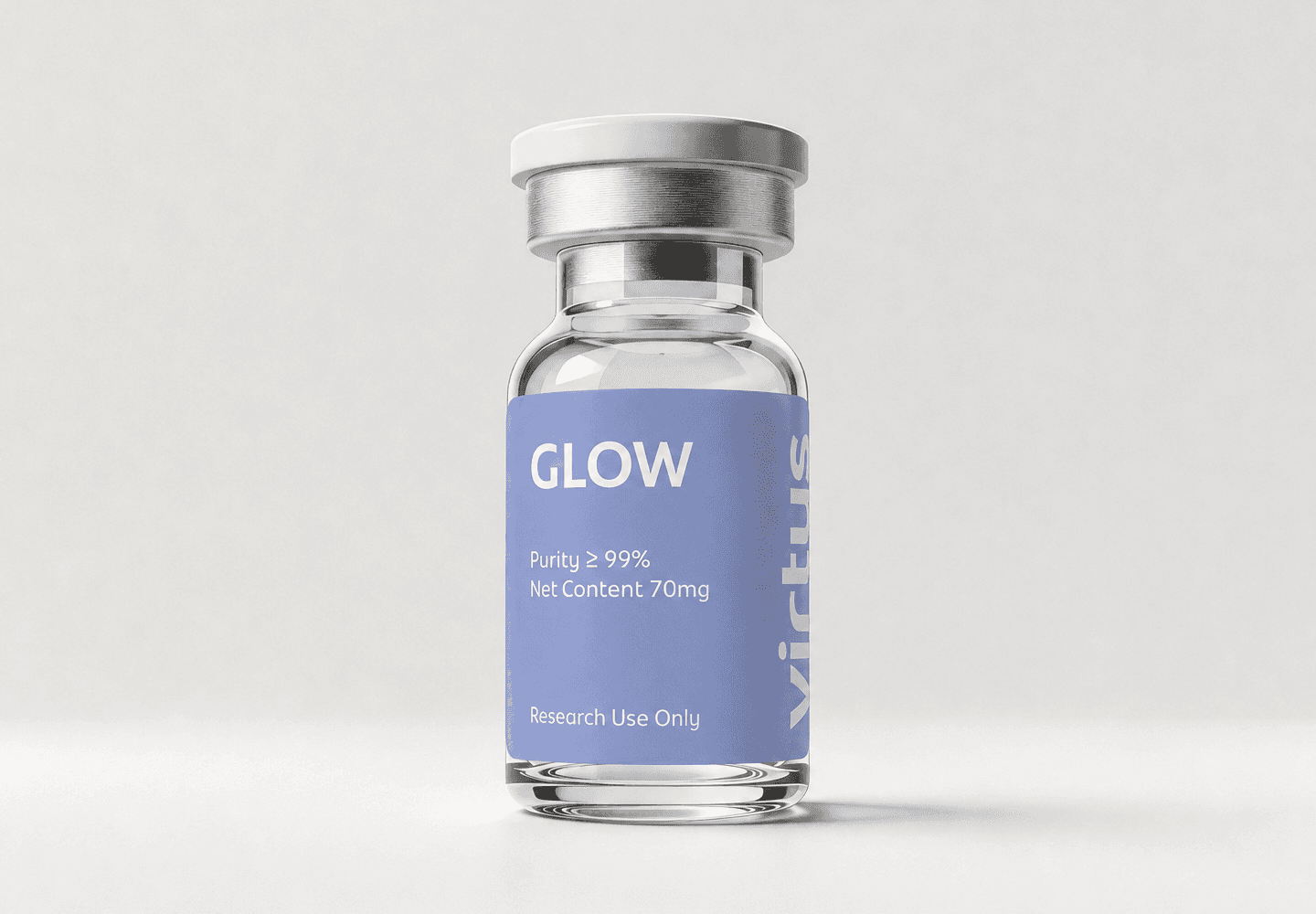
GLOW
GHK‑Cu + BPC‑157 + TB‑500: Triple Peptide Blend
Also referenced as: GHK-Cu / BPC-157 / TB-500 Blend · Triple Peptide Research Blend · GHK-Cu / BPC-157 / TB-500 Blend
≥99% Purity Guaranteed
Full Panel COA
Free Shipping At $125+
Shipping Protection
Lab Results
| Test | Result | Status |
|---|---|---|
| Purity | 99.95% | PASS |
| Quantitation (Avg) | 73.32 mg | PASS |
| Heavy Metals (ICP-MS) | Pass | PASS |
| Endotoxin (USP <85>) | 0.174 EU/mL | PASS |
| Rapid Microbial Screen | No Growth | PASS |
| Multi Vial Tested | 5 Vials | PASS |
Heavy Metals Breakdown (ICP-MS)
| Analyte | Result | Status |
|---|---|---|
| Arsenic (As) | 0.1483 ppm | PASS |
| Cadmium (Cd) | Not Detected | PASS |
| Lead (Pb) | 0.0523 ppm | PASS |
| Mercury (Hg) | Not Detected | PASS |
| Chromium (Cr) | 0.4314 ppm | PASS |
LOT PS-20260601-GL01 · Batch GL70-847-PURPLE · Tested Jul 7, 2026 · ILS
Curated research on GLOW
Pickart L (2018). Regenerative and Protective Actions of the GHK-Cu Peptide in the Light of the New Gene Data Int J Mol Sci.
PMID: 29986520 →Seiwerth S (2021). Stable Gastric Pentadecapeptide BPC 157 and Wound Healing Front Pharmacol.
PMID: 34267654 →Goldstein AL (2005). Thymosin beta4: actin-sequestering protein moonlights to repair injured tissues Trends Mol Med.
PMID: 16099219 →Bock-Marquette I (2004). Thymosin β4 activates integrin-linked kinase and promotes cardiac cell migration, survival and cardiac repair Nature.
PMID: 15580368 →
About GLOW
A precision triple-peptide research blend combining GHK-Cu (50mg), BPC-157 (10mg), and TB-500 (10mg) in a single 70mg lyophilized vial. Formulated for researchers studying the synergistic interactions of copper-binding tripeptides and synthetic peptide analogues across cellular signaling, extracellular matrix modeling, and actin-binding pathway research.
GHK-Cu modulates extracellular matrix composition and metal-ion interaction pathways. BPC-157 is investigated for its role in angiogenesis pathway research and cytokine modulation in cellular models. TB-500 contributes to actin-binding protein upregulation and cell migration studies. Each component has been independently investigated in peer-reviewed preclinical literature.
Also Referenced As
GHK-Cu / BPC-157 / TB-500 Blend · Triple Peptide Research Blend · GHK-Cu / BPC-157 / TB-500 Blend
Sourced through an established North American supply partner that conducts onsite manufacturer reviews against documented cGMP practices and applicable ISO quality criteria. Virtus Peptides tracks the factory batch number on every lot and catalogues it against independent lab testing, with a final Certificate of Analysis from ILS Laboratories. We pay more to source this way because we hold ourselves to a rigorous, documented standard for the product and for you.
Specifications
- Scientific Name
- GHK-Cu + BPC-157 + TB-500: Triple Peptide Research Blend
- CAS Number
- 49557-75-7 / 137525-51-0 / 77591-33-4
- Molecular Formula
- GHK-Cu C₁₄H₂₄CuN₆O₄ · BPC-157 C₆₂H₉₈N₁₆O₂₂ · TB-500 C₂₁₂H₃₅₀N₅₆O₇₈S
- Molecular Weight
- Blend: GHK-Cu 403.9 g/mol · BPC-157 1419.54 g/mol · TB-500 4963.49 g/mol
- Physical Form
- Lyophilized powder
- Purity
- 99%+
- LOT Number
- PS-20260601-GL01
- Batch Number
- GL70-847-PURPLE
- Storage
- −20°C, protected from light
Storage & Handling
Store per the product label and available manufacturer handling documentation, and follow standard laboratory protocols for handling.
Storage
Store the lyophilized powder at −20°C in a standard laboratory freezer, protected from light, moisture, and heat. Avoid repeated freeze-thaw cycles.
Shelf Life
Per the manufacturer, the lyophilized powder remains stable for 12–24 months when stored frozen in its original sealed vial. Our release testing verifies identity, purity, content, and the contaminant panels and does not itself establish shelf life.
Mechanism & Research Background
GLOW combines three of the most extensively studied research peptides into a single 70mg lyophilized vial: GHK-Cu (50mg), BPC-157 (10mg), and TB-500 (10mg). The component selection reflects a research design rationale grounded in the distinct, complementary cellular pathways each peptide engages: copper-binding tripeptide chemistry (GHK-Cu), gastric pentadecapeptide signaling (BPC-157), and actin-sequestering protein activity (TB-500 / thymosin β4 fragment). Each component has been independently characterized in peer-reviewed preclinical literature, allowing researchers to investigate potential synergistic interactions across multiple cellular signaling axes in controlled in-vitro environments.
In receptor and pathway research, the three components engage non-overlapping mechanisms. GHK-Cu (Glycyl-L-Histidyl-L-Lysine Copper) acts as a copper-ion shuttle and transcriptional modulator, with characterized effects on extracellular matrix turnover, redox balance, and gene-expression networks examined extensively by Pickart and colleagues (Int J Mol Sci, 2018; Biomed Res Int, 2015). BPC-157 (Body Protection Compound 157) is a synthetic 15-amino acid pentadecapeptide derived from a sequence in human gastric juice; its research literature spans angiogenesis pathway modulation, nitric oxide signaling, and cytokine regulation (Seiwerth et al., Front Pharmacol, 2021). TB-500 is a synthetic fragment of thymosin β4 with characterized actin-sequestering and cell-migration activity (Goldstein et al., Trends Mol Med, 2005).
The blend formulation is intended for research applications where investigators want to study combined or sequential exposure to all three peptides without the variability introduced by three separately reconstituted preparations. Each batch is independently tested at ILS Laboratories: purity and quantitation by HPLC, heavy metals by ICP-MS (lead, arsenic, cadmium, chromium, and mercury), bacterial endotoxin by USP <85>, and a rapid microbial screen (DNA microarray), with three vials providing the material for the complete ILS panel and two additional vials each tested for HPLC purity, identity, and net peptide content to evaluate conformity; the Certificate of Analysis reflects the combined-peptide composition. Products supplied by Virtus Peptides are for in vitro laboratory research use only, not for human or veterinary use, not for diagnostic, therapeutic, or clinical use, and not intended for consumption or administration.
Frequently Researched Questions
What is GLOW?
GLOW is a precision research blend combining three peptides in a single 70mg lyophilized vial: GHK-Cu (50mg), BPC-157 (10mg), and TB-500 (10mg). The blend is formulated for researchers studying potential synergistic interactions across copper-binding tripeptide chemistry, gastric pentadecapeptide signaling, and actin-sequestering protein activity in controlled in-vitro environments.
What are the three peptides in GLOW and how much of each?
GLOW contains 50mg GHK-Cu, 10mg BPC-157, and 10mg TB-500, a total of 70mg lyophilized peptide per vial. Each component has been independently characterized in peer-reviewed preclinical research literature on PubMed.
Why combine these three peptides specifically?
The component selection reflects three complementary, non-overlapping cellular pathways: GHK-Cu modulates extracellular matrix turnover and redox balance; BPC-157 has been studied in angiogenesis pathway and cytokine signaling research; TB-500 contributes characterized actin-sequestering and cell-migration activity. The blend allows researchers to examine combined exposure without the experimental variability of three separately reconstituted preparations.
Is GLOW tested differently than single-compound products?
Every batch of GLOW is independently tested by ILS Laboratories (ISO/IEC 17025 accredited) across the full QC panel: purity and quantitation by HPLC, heavy metals by ICP-MS (lead, arsenic, cadmium, chromium, and mercury), bacterial endotoxin by USP <85>, and a rapid microbial screen (DNA microarray). Three vials provide the material required for the complete ILS quality control panel, and two additional vials are each tested for HPLC purity, identity, and net peptide content to evaluate conformity. The Certificate of Analysis reflects the combined-peptide composition.
What is the storage recommendation for GLOW?
Lyophilized GLOW should be stored at −20°C, protected from light, in the original sealed vial. Repeated freeze-thaw cycles should be avoided. Per the manufacturer, the sealed lyophilized material has a stated frozen storage period of 12 to 24 months. Virtus Peptides release testing does not independently establish product shelf life.
Where can I find published research on the components of GLOW?
PubMed indexes peer-reviewed research on each component independently: search "GHK-Cu" or "Pickart" for the copper-binding tripeptide literature, "BPC-157" or "Seiwerth Sikiric" for the gastric pentadecapeptide research, and "TB-500" or "Thymosin beta-4" for the thymosin β4 fragment literature.